Festival Maker
Lesson 5: The Music Festival
On the festival's final day, students prepare to present their festival designs, share them through a whole-group share-out or a gallery walk, and reflect on how their music, data, and loot informed their design choices.
Overview
Students complete their festival models and share their designs through structured presentations or a gallery walk. They explain how their use of music, data, and loot informed their design decisions.
Student Objectives
- ✓ I can complete a festival model with my team.
- ✓ I can explain how data informed our design.
- ✓ I can connect songs, creatures, and loot to model features.
- ✓ I can give and receive feedback.
- ✓ I can reflect on how I used the Data Habits of Mind.
At a Glance
Total: about 45 minutes-
Welcome & Grounding
5 min · Slides 2–4
Play music as students enter. Students envision their dream festival, thinking about who would be their headlining performer and why.
-
Connector: Who Are You at a Festival?
2 min · Slides 5
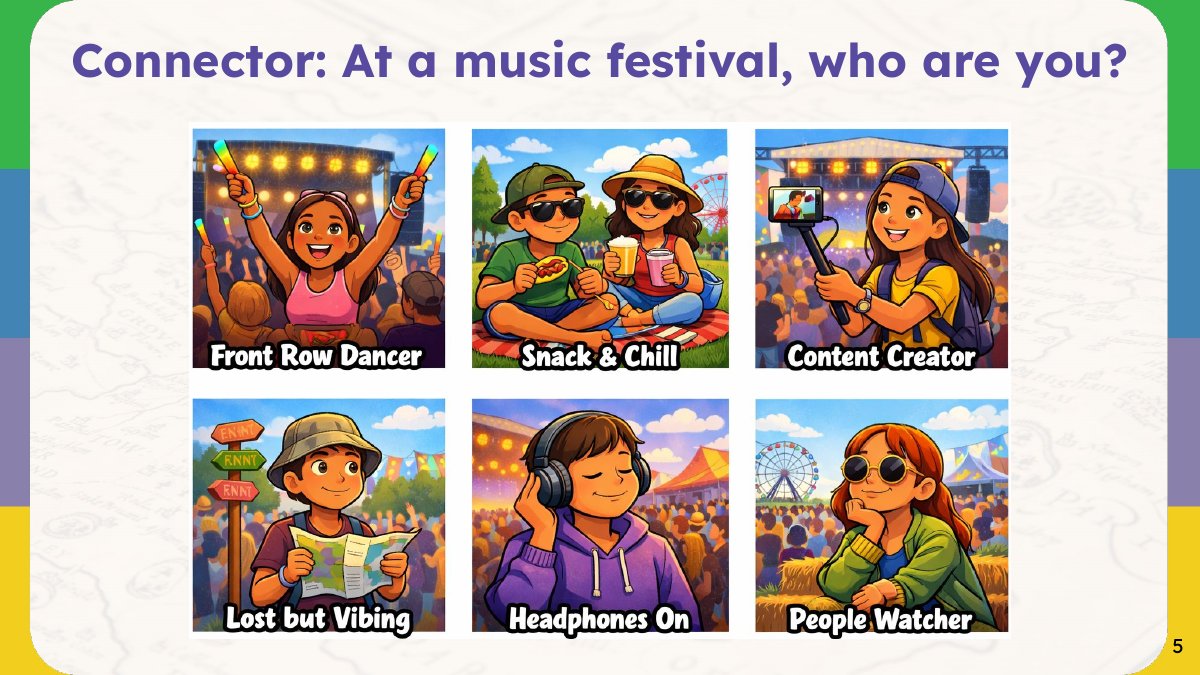
Students respond to the prompt: "At a music festival, who are you?" — a quick warm-up that reconnects students to the festival theme before they share.
-
Review Visual Agenda & Agreements
3 min · Slides 6–7
Review "Today's Adventure" and revisit the classroom agreements, reinforcing expectations for sharing and feedback.
-
Planning Festival Presentation with Your Team
8 min · Slides 8–10
Teams prepare to share their festival design. The materials offer two approaches — a gallery walk or a whole-class share-out — so hide or skip the slide you are not using. If models are not already at tables, have a student bring them over. Teams then spend about 7 minutes using the prompts to communicate their findings: for a share-out, select 1–2 features to highlight and decide who will speak; for a gallery walk, set up models with labels and sticky notes for feedback.
-
Presenting Your Festival to Other Teams
17 min · Slides 11–14
Teams take turns presenting or exploring the models. Choose your format. Slide 12 (Whole-Group Share-Out): each team presents, using the prompts to communicate the key parts of their project. Slide 13 (Gallery Walk with rotation): students leave "I Like," "I Wonder," and "Next Steps" feedback on sticky notes at each model.
-
Presentation Reflection
5 min · Slides 14
Students reflect on their model, the feedback they received, and how it represents their data and choices. They share what their next model would be or what they would change with more time.
-
Reflection & Closing Ritual
5 min · Slides 15–16
Students make a connection to one of the Data Habits of Mind, then check in on their emotions and identify how they feel at the end of the lesson.
| Section | Time | Slides | What happens |
|---|---|---|---|
| Welcome & Grounding | 5 min | 2–4 | Play music as students enter. Students envision their dream festival, thinking about who would be their headlining performer and why. |
| Connector: Who Are You at a Festival? | 2 min | 5 | Students respond to the prompt: "At a music festival, who are you?" — a quick warm-up that reconnects students to the festival theme before they share. |
| Review Visual Agenda & Agreements | 3 min | 6–7 | Review "Today's Adventure" and revisit the classroom agreements, reinforcing expectations for sharing and feedback. |
| Planning Festival Presentation with Your Team | 8 min | 8–10 | Teams prepare to share their festival design. The materials offer two approaches — a gallery walk or a whole-class share-out — so hide or skip the slide you are not using. If models are not already at tables, have a student bring them over. Teams then spend about 7 minutes using the prompts to communicate their findings: for a share-out, select 1–2 features to highlight and decide who will speak; for a gallery walk, set up models with labels and sticky notes for feedback. |
| Presenting Your Festival to Other Teams | 17 min | 11–14 | Teams take turns presenting or exploring the models. Choose your format. Slide 12 (Whole-Group Share-Out): each team presents, using the prompts to communicate the key parts of their project. Slide 13 (Gallery Walk with rotation): students leave "I Like," "I Wonder," and "Next Steps" feedback on sticky notes at each model. |
| Presentation Reflection | 5 min | 14 | Students reflect on their model, the feedback they received, and how it represents their data and choices. They share what their next model would be or what they would change with more time. |
| Reflection & Closing Ritual | 5 min | 15–16 | Students make a connection to one of the Data Habits of Mind, then check in on their emotions and identify how they feel at the end of the lesson. |
Materials & Prep
- No materials to print for this lesson.
- Student festival modelsThe 3D festival designs groups built across the week, ready to present or display.
- Sticky notesFor gallery-walk feedback (I Like… / I Wonder… / Next Steps…).
- Data Habits of Mind TrackerCarried over from Avatar Maker. Used for the closing reflection.
- Facilitation Slide Deck — Day 5Needs a computer with sound and a projector.
- Ensure students have access to their festival models.
- Set up the space for sharing — presentation or gallery walk — and hide the slides for the option you are not using.
- Cue music for arrival.
- Display the visual agenda and sensory guide.
- Take photos of festival models.
- Reflect on pacing, engagement, and quality of explanations.
- Note student understanding of how data connects to design choices.
Slides & Teaching Guide
How to use these speaker notes
Every slide's notes follow the same four labels so you can find what you need at a glance.
- Time:
- Approximate pacing for the slide.
- Example Script:
- Suggested language to say to students. Paraphrase freely to match your voice.
- Do:
- Appears only when a specific action or facilitation move is needed (invite a volunteer, collect a data sheet, etc.). If you don't see a "Do" line, the script is all that's needed.
- Purpose:
- Why the slide is here and what it's building toward in the lesson.
-
Slide 2 · Lesson 5
No teaching notes for this slide.
-
Slide 3 · Lesson Five
1 min.Today is the final part of our music festival adventure. Your team will share your design and explain how your music, data, creatures, and loot shaped the choices you made.
Purpose: Introduces the final day of Festival Maker and prepares students to share and celebrate their completed festival designs.
-
Slide 4 · Welcoming and Grounding
5 minIf you organized an epic music festival, who would be your headlining performers? Now connect that thinking to your festival model. What kind of feeling, energy, or experience does your team’s festival create for your creatures?
Do: Play music as students enter. (Linked to the upper right corner of the slide). Invite a few students to share if time allows.
Purpose: Activates thinking about music festivals and helps students connect personally to the day's celebration and sharing activities.
-
Slide 5 · Connector: At a music festival, who are you?
2 minLook at the six options on the slide. If you were at a music festival today, who would you be? Would you be the Front Row Dancer, Snack & Chill, Content Creator, Lost but Vibing, Headphones On, or People Watcher? Pick one and think about why you connected with it. You can share with a partner or keep it as a quiet reflection.
Do: Give students 30–60 seconds to choose. Invite students to share with a partner. Call on a few volunteers if time allows.
Purpose: Builds community and encourages students to connect through personal interests and experiences.
-
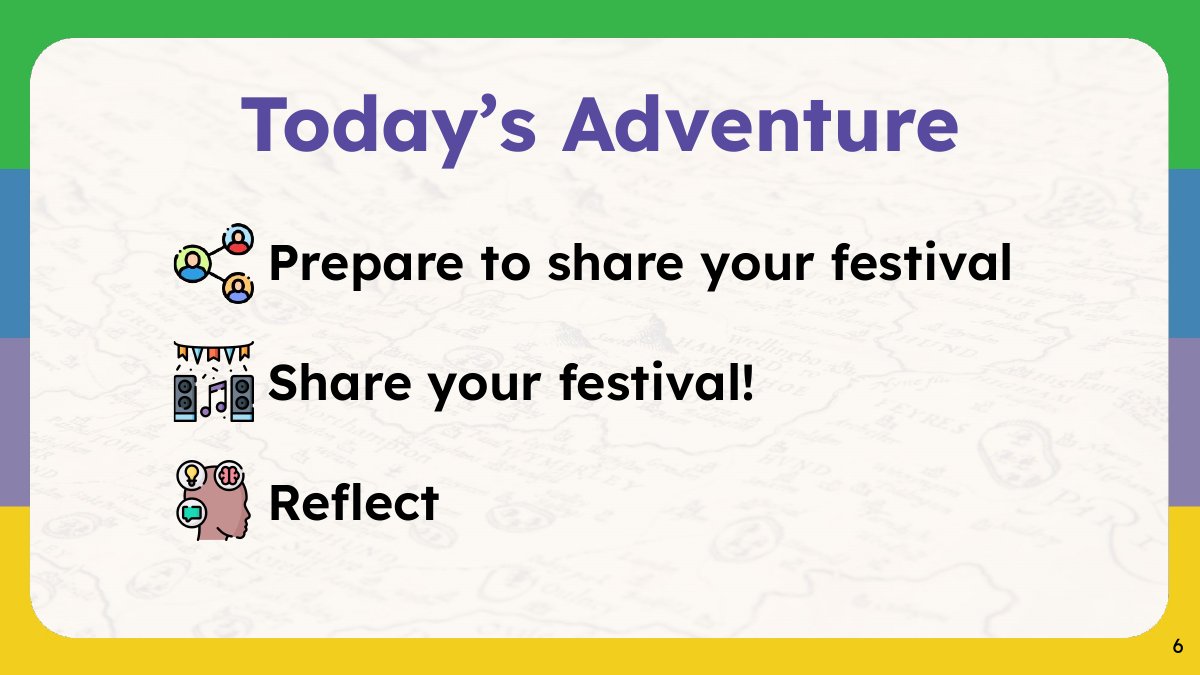
Slide 6 · Today’s Adventure
2 minHere is our plan for today. First, we will ground ourselves and then you’ll have time with your team to plan a quick introduction and presentation for your music festival (and all of it’s epic features..) Then we will share and celebrate! * you can share how they will be presenting, either through whole-group share-out or a gallery walk.
Do: Choose which sharing format you will use: Option A (whole-group share-out) or Option B (gallery walk) and share with students.
Purpose: Provides an overview of the day's activities and helps students understand the sequence of sharing and reflection.
-
Slide 7 · Our Classroom Agreements
1 minuteBefore we start, let’s return to our classroom agreements. These agreements help us work as teams, try new ideas, and make sure everyone has a way to participate. As we play today, we will need to listen, take turns, use evidence, and help each other stay with the process.
Purpose: Reinforces shared expectations that support respectful listening, presenting, and providing feedback.
-
Slide 8 · Planning Time
Students are given 8 minutes to plan presentationsNow let’s start planning what we want to share about the Festival Models we made yesterday!
Purpose: transition
-
Slide 9 · Set up your Festival Model
2 minGet your model ready for prime time! Make sure you have all of the elements of your model placed where you want them. Feel free to add labels if they might help people looking at your models to know about the features you built!
Do: Choose which sharing format you will use: Option A (whole-group share-out) or Option B (gallery walk) and share with students.
Purpose: Provides an overview of the day's activities and helps students understand the sequence of sharing and reflection.
-
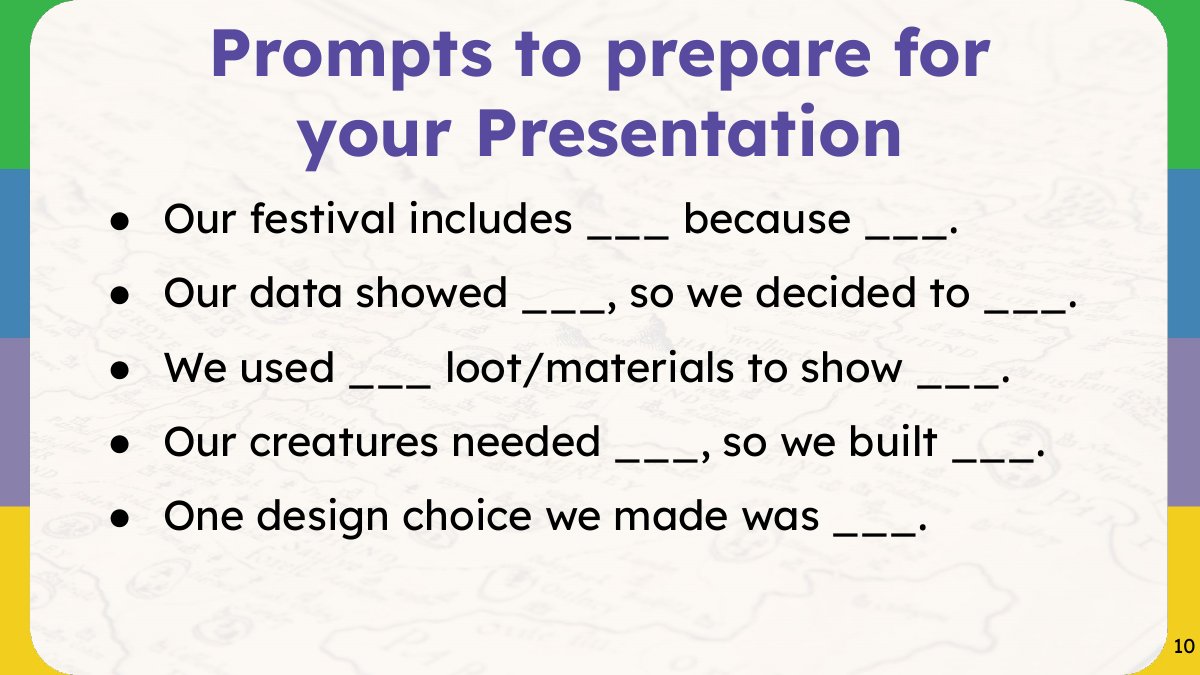
Slide 10 · Prompts to prepare for your Presentation
6 minBefore we share, take a few minutes to prepare your explanation. When your team shares, you will need to tell us about your festival and what your creatures built. Then explain what your design tells us about the data in your playlist. Also think about who will present when it’s your turn nto share!
Do: Give teams 6 minutes to prepare their presentation. If students are doing a gallery walk, instruct them to write out their responses on a piece of paper to leave behind with their model. If students will be sharing in whole group, remind teams to decide how each person will participate: speak, point, hold the model, read a sentence/
Purpose: Supports students in communicating their design decisions and explaining how data informed their festival model.
-
Slide 11 · Festival Sharing
Students are given 17 minutes for their presentationsTime to present!
Purpose: transition
-
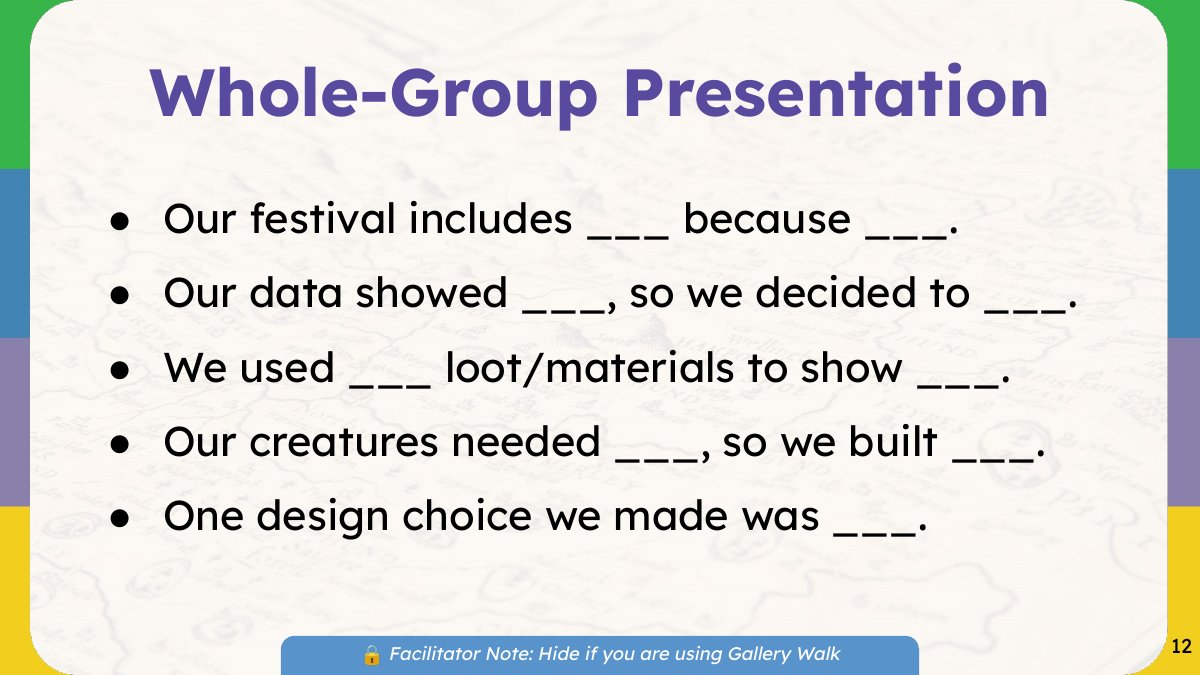
Slide 12 · Whole-Group Presentation
17 min Hide this slide if you chose to have students complete a Gallery WalkTell us about your festival and what your creatures built. Then explain what your design tells us about the data in your playlist.
Do: Facilitate team sharing
Purpose: Supports students in communicating their design decisions and explaining how data informed their festival model.
-
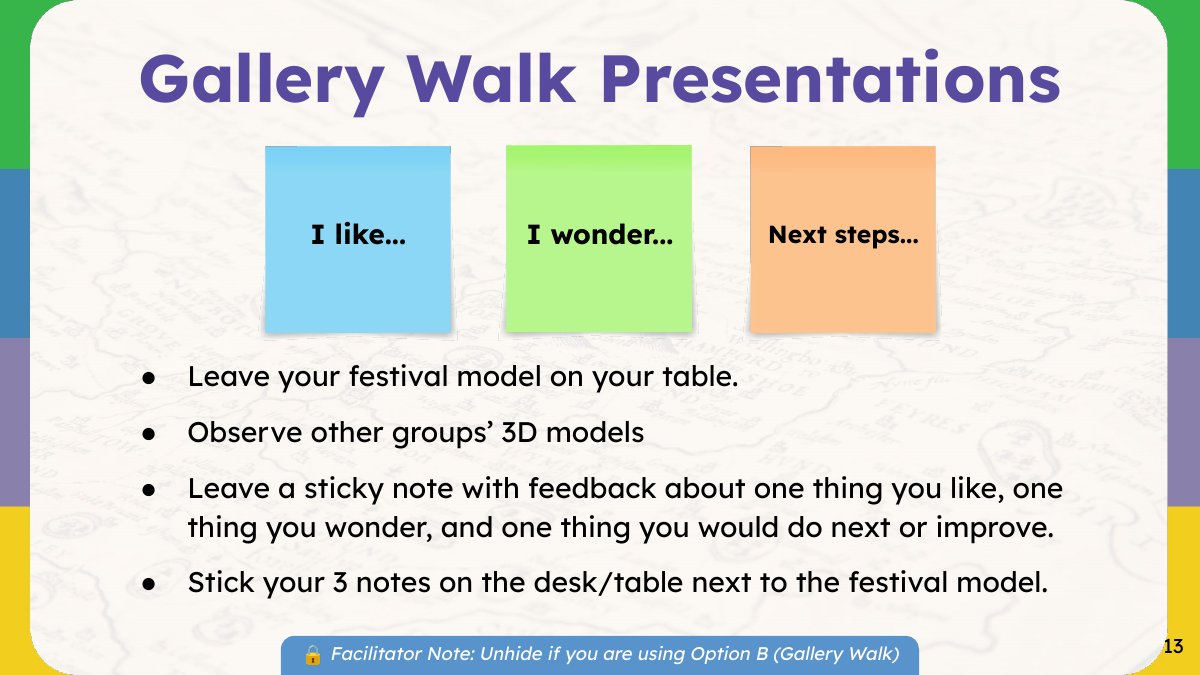
Slide 13 · Gallery Walk Presentations
17 min. Unhide this slide if you chose to have students complete a Gallery WalkFor the gallery walk, your team will leave your festival model on your table. You will visit other teams’ models and look closely at their design choices. As you visit, leave feedback using three kinds of notes: I like… I wonder… Next steps… Your feedback should be kind, specific, and useful.
Do: Model one strong feedback example and one weak example. Give students a clear number of models to visit or a clear time limit.
Purpose: Encourages students to learn from one another's designs while practicing observation, feedback, and reflection skills.
-
Slide 14 · Presentation Reflection
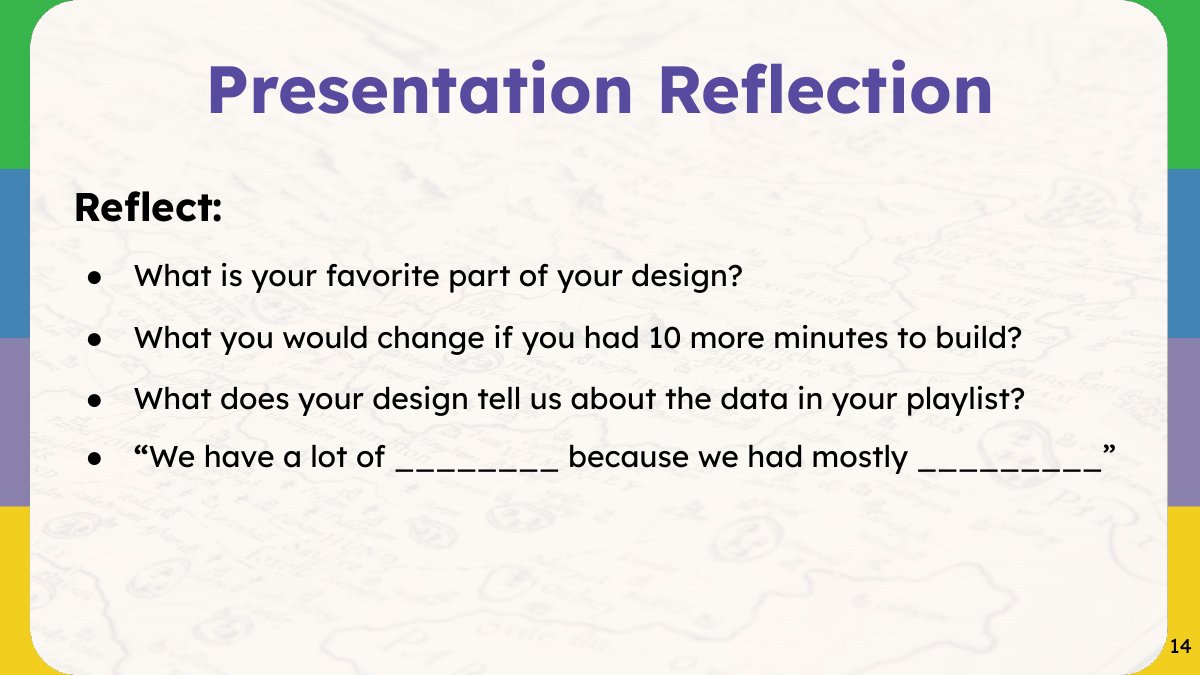
5 minNow that you have shared, observed, and received feedback, take a moment to reflect with your team. Think about: What is your favorite part of your design? What would you change if you had 10 more minutes? What does your design tell us about the data in your playlist?
Do: Let students respond orally with a partner, in writing, or as a team discussion. Invite a few volunteers to share if time allows.
Purpose: Helps students reflect on their design process, evaluate their work, and connect their festival design back to the data they analyzed. Other benefits: Sometimes students want to continue to build and refine their model, giving them the opportunity to share what they would do next can help them surface that without being able to continue building.
-
Slide 15 · Reflection: Look at your Data Habits of Mind Tracker
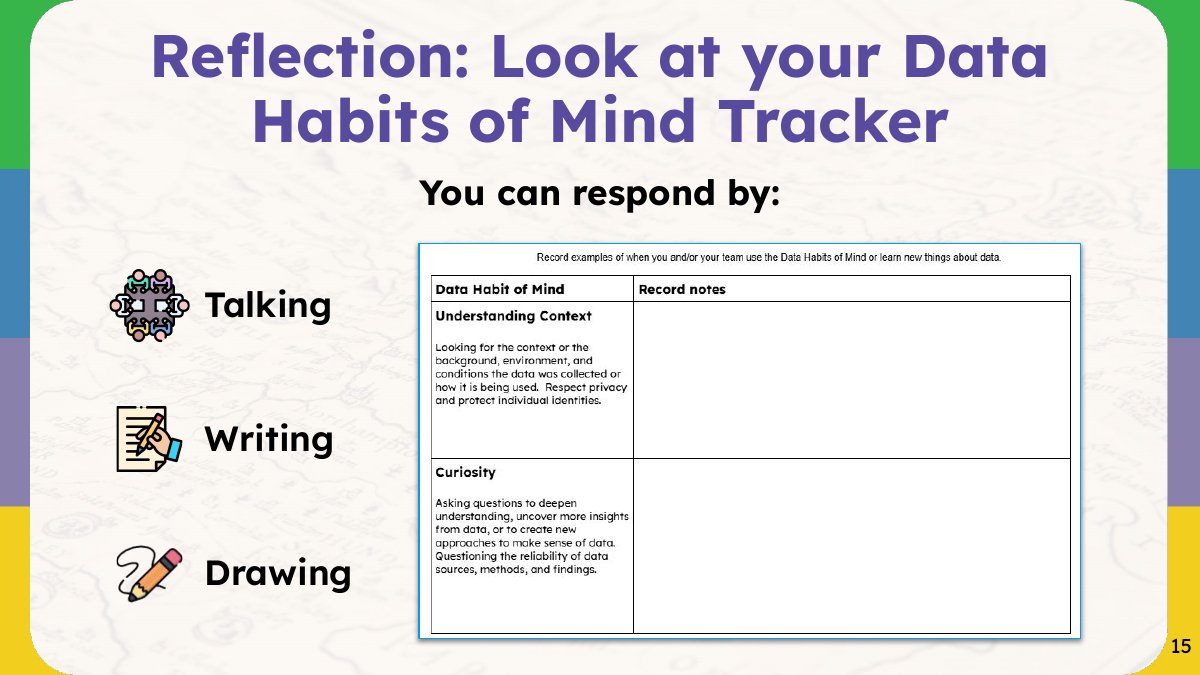
4 minNow make a connection to one of the Data Habits of Mind using your tracker. You can think about curiosity, context, communication, or perseverance. Record your connection in the tracker. You can write, draw, or use words that make sense to you. There is no one right answer. You might have used curiosity when you explored a station, context when you thought about music choices, communication when you shared with a partner, or perseverance when something felt confusing.
Do: Direct students to the Data Habits of Mind Tracker. Ask students to choose one Data Habit of Mind. Have students record a connection in the tracker. Allow multiple response modes: writing, drawing, talking first, or quiet reflection.
Purpose: Encourages students to reflect on how they used Data Habits of Mind throughout the Festival Maker experience.
-
Slide 16 · Closing Ritual: Creature Reset
1 minTake a moment to breathe before we move on. Imagine your creature finding a calm, safe place in Symphonia. You do not have to say anything out loud. Just take a quiet moment to reset. Use the gif to cue you when to inhale, pause, and exhale..
Do: Play the embedded audio. Give students a quiet moment to breathe or reset.
Purpose: Provides a calm and reflective closure to the lesson while helping students transition out of the learning experience.