Festival Maker
Lesson 1: Introducing the Festival Maker Game
Students enter the world of Symphonia to explore how music, creatures, and data connect, learning how the game works and beginning to use the Data Habits of Mind.
Overview
Students enter the world of Symphonia to explore how music, creatures, and data connect. They learn how the game works, interact with key materials, and begin using data habits that will guide gameplay, data collection, and future festival design.
Student Objectives
- ✓ I can describe how the game works.
- ✓ I can identify materials and explain the data they show.
- ✓ I can use graphing tools to organize and label data.
- ✓ I can identify how I used the Data Habits of Mind.
- ✓ I can explain that gameplay will include collecting data and loot for future festival design.
At a Glance
Total: about 45 minutes-
Welcome & Grounding
5 min · Slides 2–7
Introduce the Data Adventure and orient students to their place within the three adventures, then give an overview of the five lessons and today's focus — the tools, mechanics, and Data Habits of Mind. Bring up the "Think" slide and play music as students enter, inviting them to notice how the music makes them feel.
-
Connector
4 min · Slides 8–16
Project 2–3 "Would You Rather: Music Edition" slides. Students respond by speaking, pointing, or holding up one finger (option 1) or two fingers (option 2). End with "Fast vs. slow" and "Loud vs. quiet."
-
Review Visual Agenda & Create Agreements
2 min · Slides 17–18
Review the "Today's Adventure" slide. Co-create classroom agreements or review premade ones, focusing on what supports safety, inclusion, and participation. Connect the agreements to the upcoming group work.
-
Station Rotation
25 min · Slides 19–21
Small groups rotate through four stations — 3 minutes to explore and respond to the table tent questions, 1 minute to rotate. Students interact with creature cards, song sheets, graphing tools, and data habits, noticing how music data connects to decisions in the game. Close with a whole-group share-out where each group shares one discovery. Record key vocabulary on chart paper and reinforce it during discussion: data, tempo, loudness, graph, Data Habits of Mind, curiosity, context, communication, perseverance.
-
The Story of Festival Maker
5 min · Slides 22
Before viewing, ask students to notice connections to the stations. Show "The Story of Festival Maker" video, then share connections and observations about music, data, and decision-making. Reinforce that gameplay will include collecting data and loot for future festival design.
-
Reflection & Closing Ritual
4 min · Slides 23–24
Students make a connection to one Data Habit of Mind and record it in the Data Habits of Mind Tracker. Guide students through a brief "Creature Reset" calming routine.
| Section | Time | Slides | What happens |
|---|---|---|---|
| Welcome & Grounding | 5 min | 2–7 | Introduce the Data Adventure and orient students to their place within the three adventures, then give an overview of the five lessons and today's focus — the tools, mechanics, and Data Habits of Mind. Bring up the "Think" slide and play music as students enter, inviting them to notice how the music makes them feel. |
| Connector | 4 min | 8–16 | Project 2–3 "Would You Rather: Music Edition" slides. Students respond by speaking, pointing, or holding up one finger (option 1) or two fingers (option 2). End with "Fast vs. slow" and "Loud vs. quiet." |
| Review Visual Agenda & Create Agreements | 2 min | 17–18 | Review the "Today's Adventure" slide. Co-create classroom agreements or review premade ones, focusing on what supports safety, inclusion, and participation. Connect the agreements to the upcoming group work. |
| Station Rotation | 25 min | 19–21 | Small groups rotate through four stations — 3 minutes to explore and respond to the table tent questions, 1 minute to rotate. Students interact with creature cards, song sheets, graphing tools, and data habits, noticing how music data connects to decisions in the game. Close with a whole-group share-out where each group shares one discovery. Record key vocabulary on chart paper and reinforce it during discussion: data, tempo, loudness, graph, Data Habits of Mind, curiosity, context, communication, perseverance. |
| The Story of Festival Maker | 5 min | 22 | Before viewing, ask students to notice connections to the stations. Show "The Story of Festival Maker" video, then share connections and observations about music, data, and decision-making. Reinforce that gameplay will include collecting data and loot for future festival design. |
| Reflection & Closing Ritual | 4 min | 23–24 | Students make a connection to one Data Habit of Mind and record it in the Data Habits of Mind Tracker. Guide students through a brief "Creature Reset" calming routine. |
Materials & Prep
- Music Station Table Tents1 setIncluded in your classroom kit. Print in color and fold lengthwise if you need extras.
- Station Rotation Creature Cards1 set per station groupPractice cards for Day 1 only. Included in your classroom kit.
- Song Sheet1 per station groupIncluded in your classroom kit.
- Graphing Mat1 per teamIncluded in your classroom kit. Printed double-sided on 11x17 cardstock (not laminated).
- Data Habits of Mind Cards1 setIncluded in your classroom kit. Print in color and cut out if you need extras.
- Data Habits of Mind TrackerCarried over from Avatar Maker. Used in the closing reflection.
- Station 1 — Card Discovery materialsMusic Station table tent (page 1), Station Rotation Cards, and a Song Sheet. Provided by the project.
- Station 2 — Website Wonder materialsWebsite Wonder table tent (page 2) and a computer or tablet connected to dataadventures.org/festival/app. Provided by the project.
- Station 3 — Graphing Mat & Translucent Range Windows materialsGraphing Mat and Tools table tent (page 3), Graphing Mat, translucent range windows, and red, yellow, and blue colored pencils. Provided by the project.
- Station 4 — Data Habits materialsData Habits of Mind table tent (page 4) and Data Habits of Mind cards. Provided by the project.
- Projector
- HeadphonesFor students to listen to songs.
- Optional supportsNoise-reducing headphones, pause cards, sentence frames, multilingual vocabulary cards, visual reference posters, and a sensory guide.
- Lesson 0: Classroom Agreements slidesCo-create your classroom agreements with the class before starting (or use the premade set in the deck). Best run as a quick "Lesson 0" ahead of this lesson.
- Facilitation Slide Deck — Day 1
- Festival Maker app — dataadventures.org/festival/appStation 2 needs a computer or tablet with internet access.
- The Story of Festival Maker videoNeeds a computer with sound and internet access.
- Study classroom? Check your classroom kit before printing or gathering materials. The Unpack your classroom kit videos on Getting Started show what is in each box and how it is organized.
- Decide whether students will co-create agreements or use the premade agreements in the slides, and hide unused agreement slides before teaching.
- Choose 2–3 artist preference slides in advance for the Would You Rather activity, and hide facilitator-only slides before presenting.
- Place one table tent at each station and set out the station materials.
- Open and test the Festival Maker video for sound and internet.
- Display the visual agenda (and Sensory Guide if using it) and cue music for arrival.
- Note any confusion about materials or gameplay structure.
- Prepare materials for gameplay practice in the next session.
Slides & Teaching Guide
How to use these speaker notes
Every slide's notes follow the same four labels so you can find what you need at a glance.
- Time:
- Approximate pacing for the slide.
- Example Script:
- Suggested language to say to students. Paraphrase freely to match your voice.
- Do:
- Appears only when a specific action or facilitation move is needed (invite a volunteer, collect a data sheet, etc.). If you don't see a "Do" line, the script is all that's needed.
- Purpose:
- Why the slide is here and what it's building toward in the lesson.
-
Slide 2 · Lesson 1
No teaching notes for this slide.
-
Slide 3 · Festival Maker Game
No teaching notes for this slide.
-
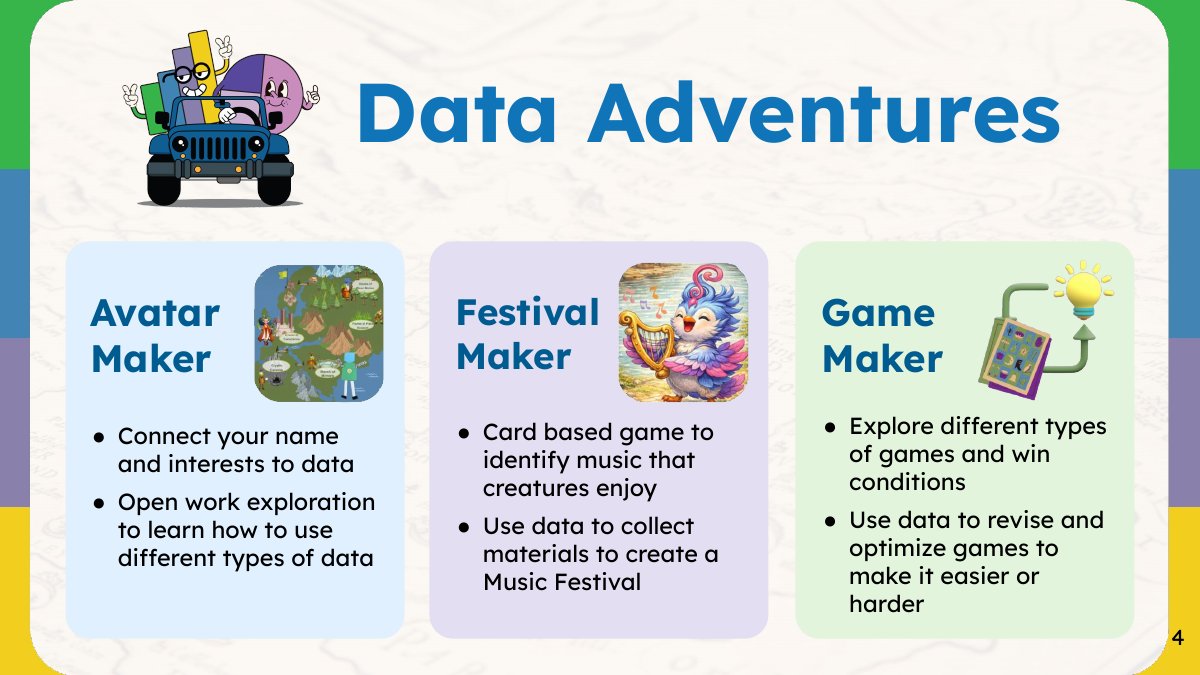
Slide 4 · Data Adventures
1 min.Over the next few days, you'll be going on a Data Adventure through three different experiences. In Avatar Maker, you'll explore how data can tell a story about who you are and what interests you. In Festival Maker, you'll use data to make decisions and design a music festival for a group of creatures. Finally, in Game Maker, you'll become game designers, using data to test, improve, and optimize your own games. Each experience builds on the one before it and helps you develop new data science and design skills.
Purpose: Provides an overview of the learning journey and helps students understand how the three experiences connect to one another.
-
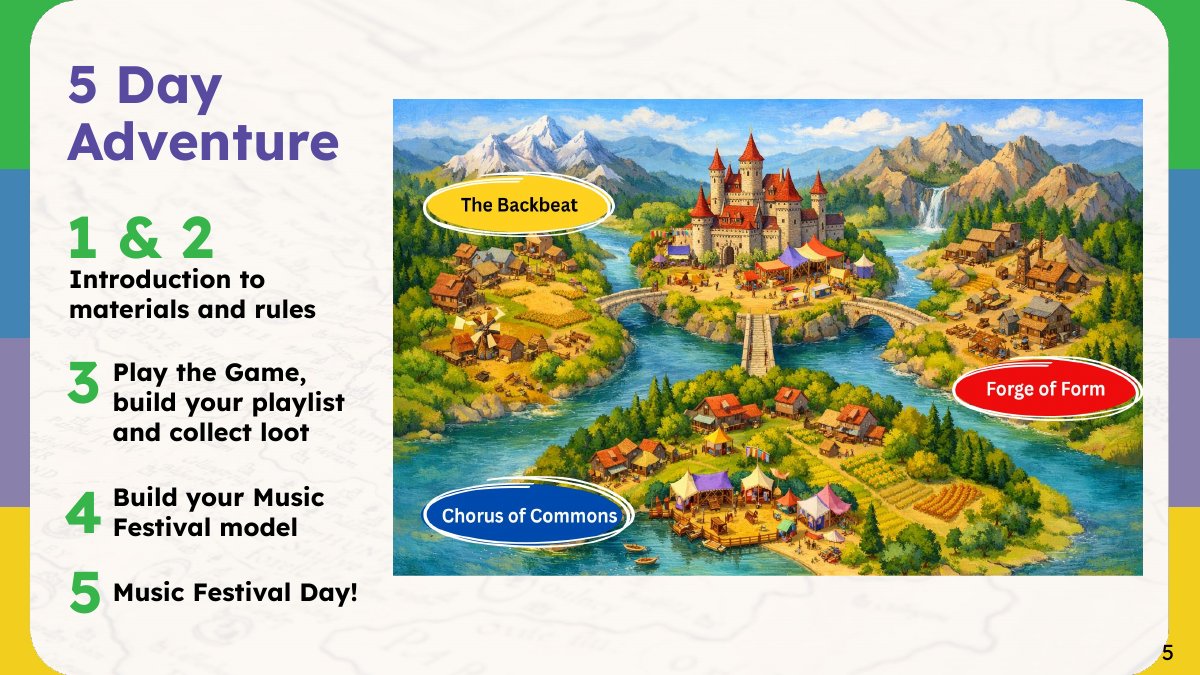
Slide 5 · 5 Day Adventure
1 min.Let's take a look at where we're headed over the next five days. This adventure takes place in a world with three different regions: The Backbeat, Chorus of Commons, and Forge of Form. As you play, you'll meet different music creatures, learn what they enjoy, and collect information to help you make decisions. During the first two days, you'll learn the materials, rules, and how to navigate the game. On Day 3, you'll play the game, build a playlist, and collect resources. On Day 4, you'll use everything you've learned to design and build a music festival model. Then on Day 5, you'll share and celebrate your festival during Music Festival Day. Each day builds on the one before it, so the information you gather along the way will help you make better design decisions later.
Purpose: Provides a roadmap for the multi-day experience and helps students understand how gameplay, data collection, and design work together throughout the adventure.
-
Slide 6 · Lesson One
1 min.Today we’re starting something new called Data Adventures. You’ll explore music, creatures, and data while learning how a game works. We are not trying to be perfect today. We are exploring, noticing, and figuring things out together. By the end of today, you should understand what Festival Maker is, explore some of the tools and materials we will use, and help create agreements for how we will work together.
-
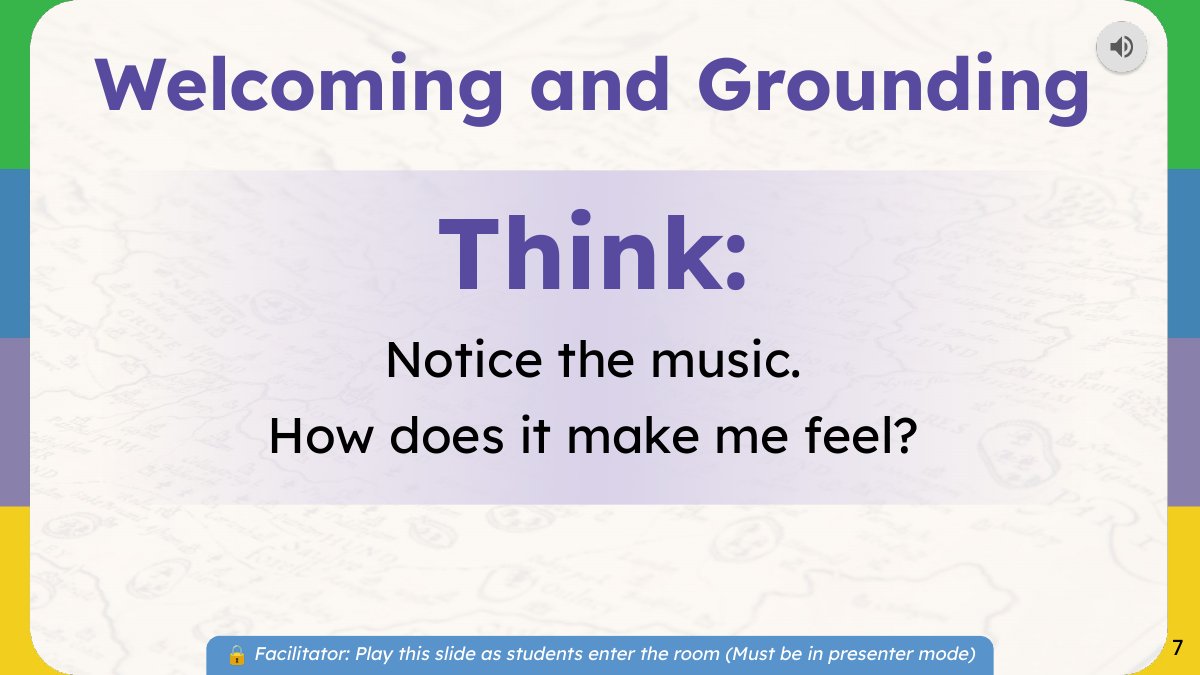
Slide 7 · Welcoming and Grounding
2 minAs you listen, notice how the music makes you feel. There is no right answer. Just pay attention to your reaction. You might notice your body, your mood, your thoughts, or the kind of energy the music gives you.
Do: Play music as students enter. (Linked to the upper right corner of the slide).
Purpose: Ground to lesson
-
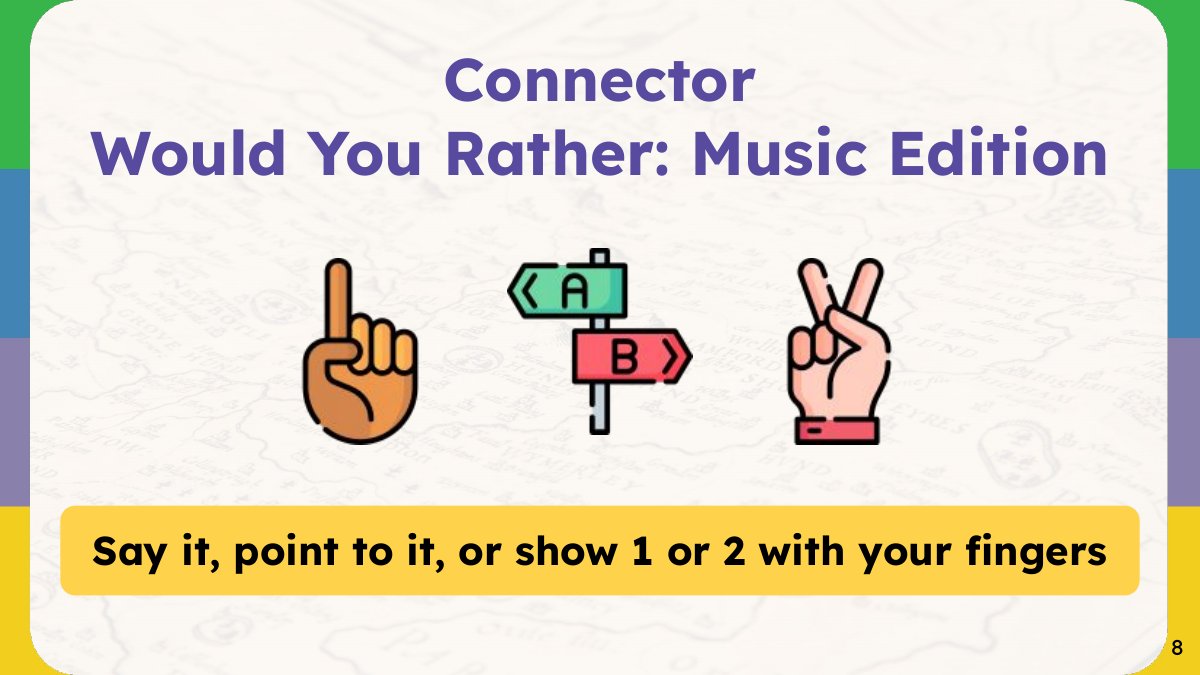
Slide 8 · Connector
4 min. total for activityNext, we’re going to warm up with a quick music choice activity. For each slide, choose which one you would rather listen to. You can say your answer, point, or show one or two with your fingers. You may pass. As we go through these choices, notice that every choice gives us information. That information is data. Later in Festival Maker, we will use data to make decisions in the game.
Purpose: Connector
-
Slide 9 · Pick 2 to 3 of the following 5 slides based on your students’ interest
No teaching notes for this slide.
-
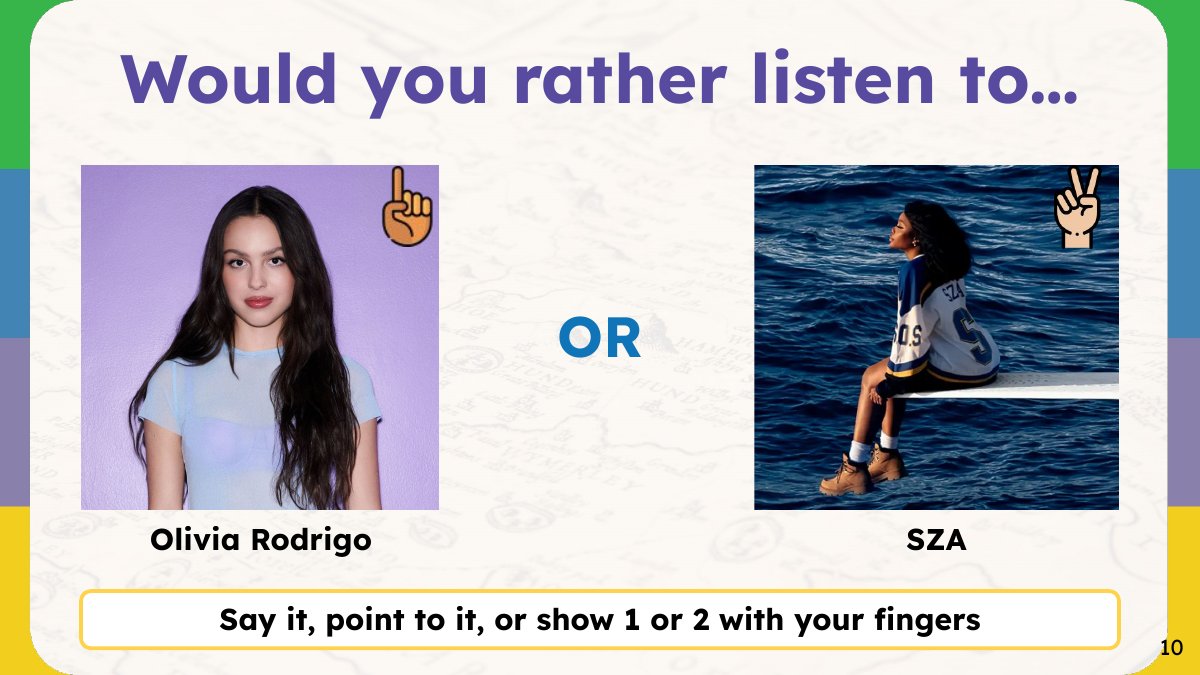
Slide 10 · Would you rather listen to…
4 min. total for activityWould you rather listen to option 1 or option 2? You can say your answer, point to it, or hold up one or two fingers. You may also pass.
Do: Connect briefly to data: “Our choices give us data about music preferences.”
-
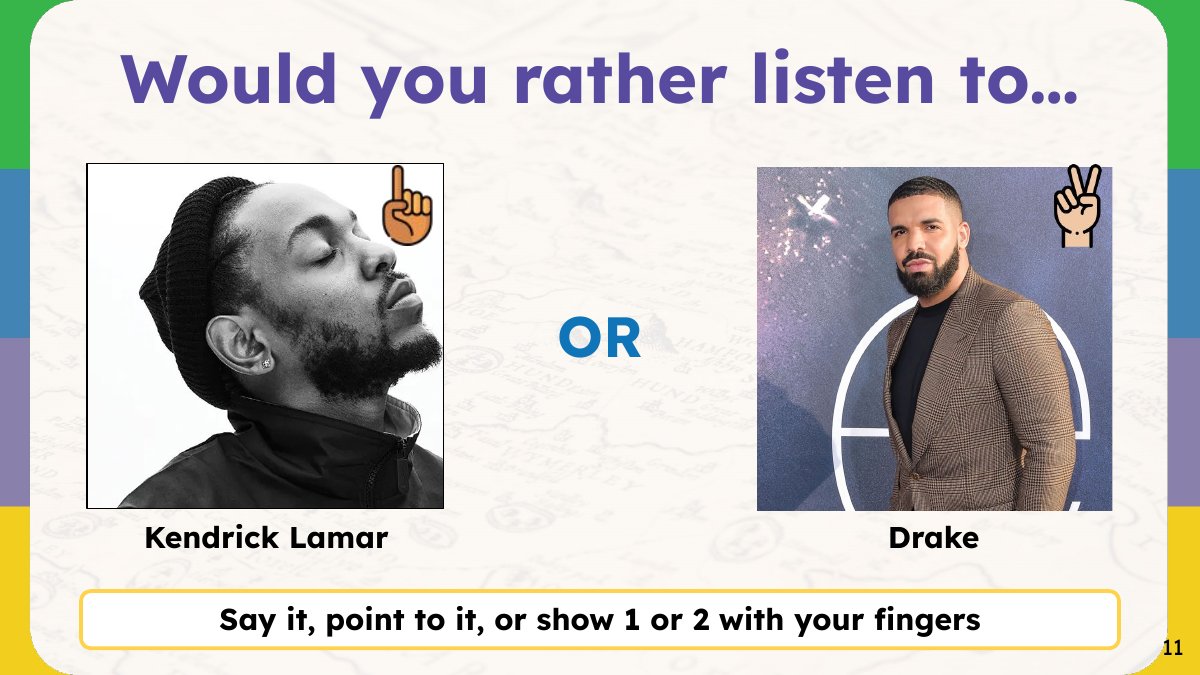
Slide 11 · Kendrick Lamar
4 min. total for activityWould you rather listen to option 1 or option 2? You can say your answer, point to it, or hold up one or two fingers. You may also pass.
Do: Connect briefly to data: “Our choices give us data about music preferences.”
-
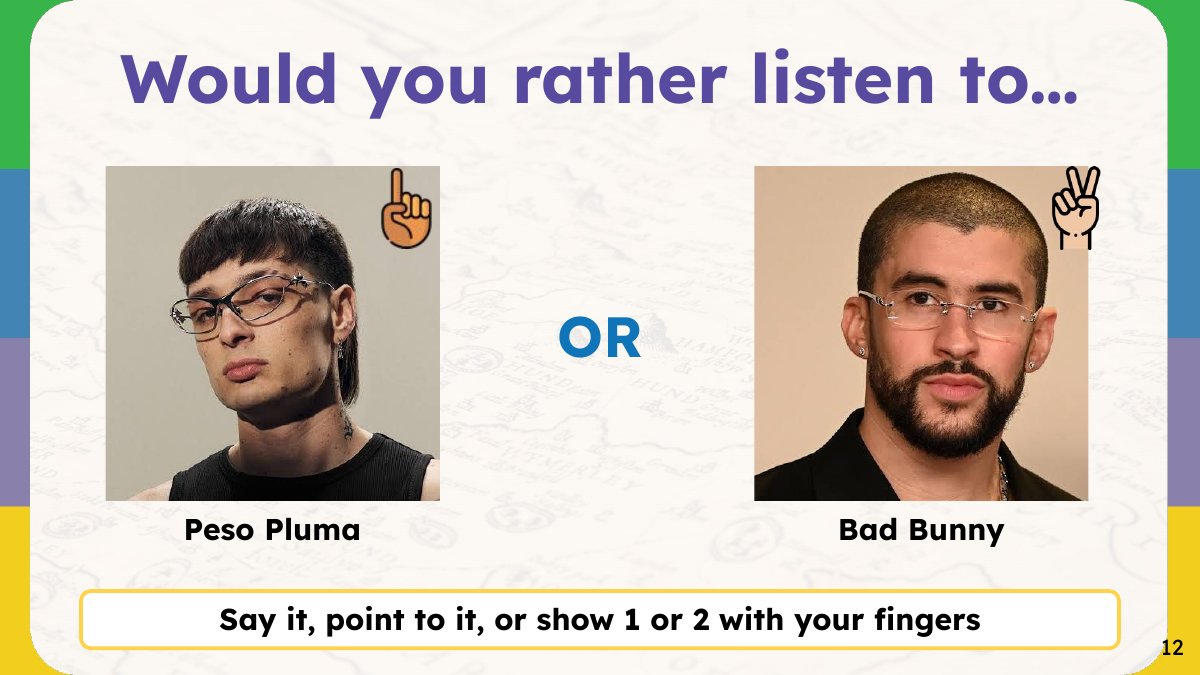
Slide 12 · Peso Pluma
4 min. total for activityWould you rather listen to option 1 or option 2? You can say your answer, point to it, or hold up one or two fingers. You may also pass.
Do: Connect briefly to data: “Our choices give us data about music preferences.”
-
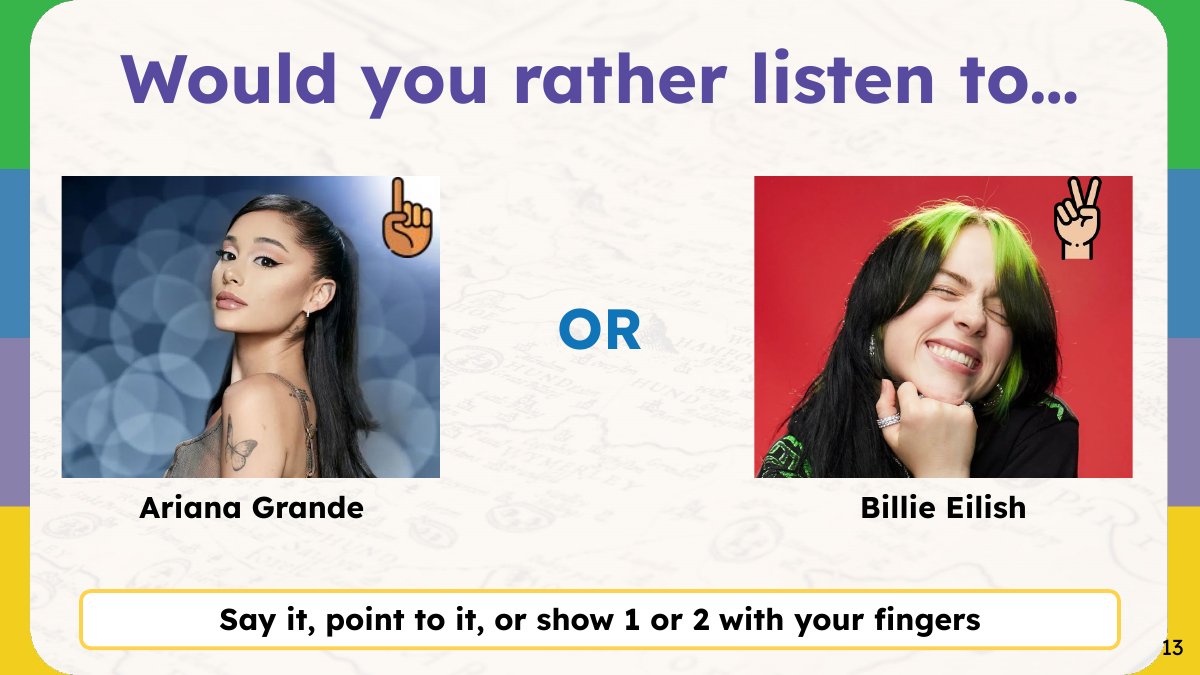
Slide 13 · Ariana Grande
4 min. total for activityWould you rather listen to option 1 or option 2? You can say your answer, point to it, or hold up one or two fingers. You may also pass.
Do: Connect briefly to data: “Our choices give us data about music preferences.”
-
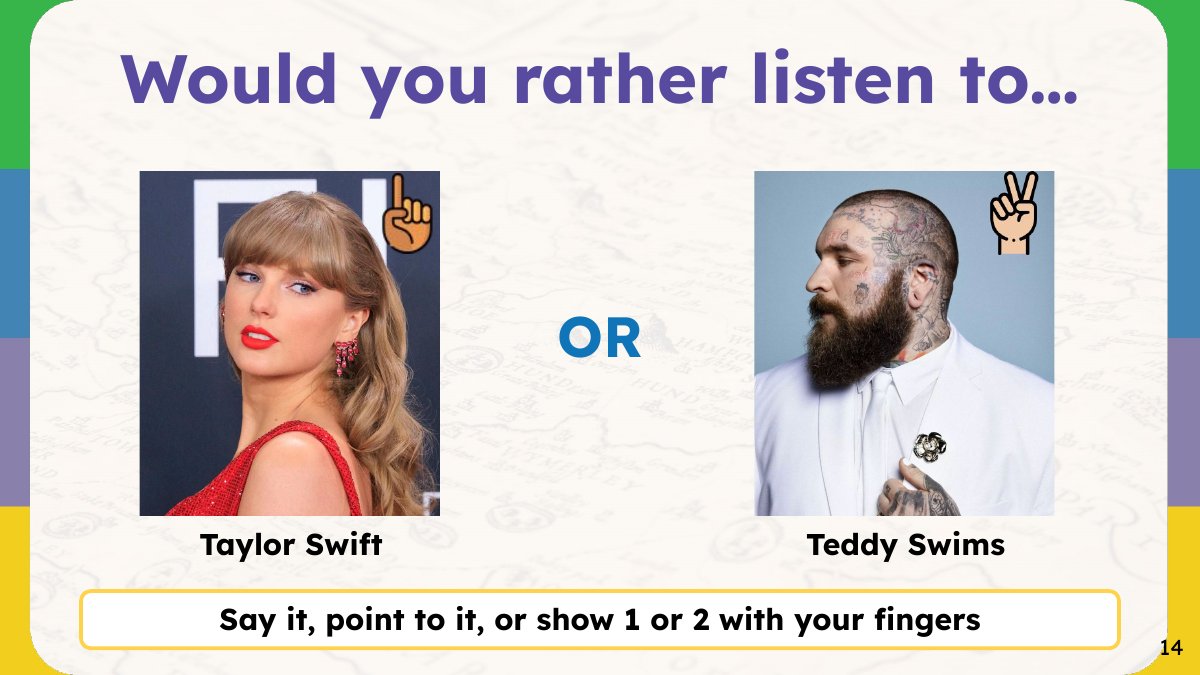
Slide 14 · Taylor Swift
4 min. total for activityWould you rather listen to option 1 or option 2? You can say your answer, point to it, or hold up one or two fingers. You may also pass.
Do: Connect briefly to data: “Our choices give us data about music preferences.”
-
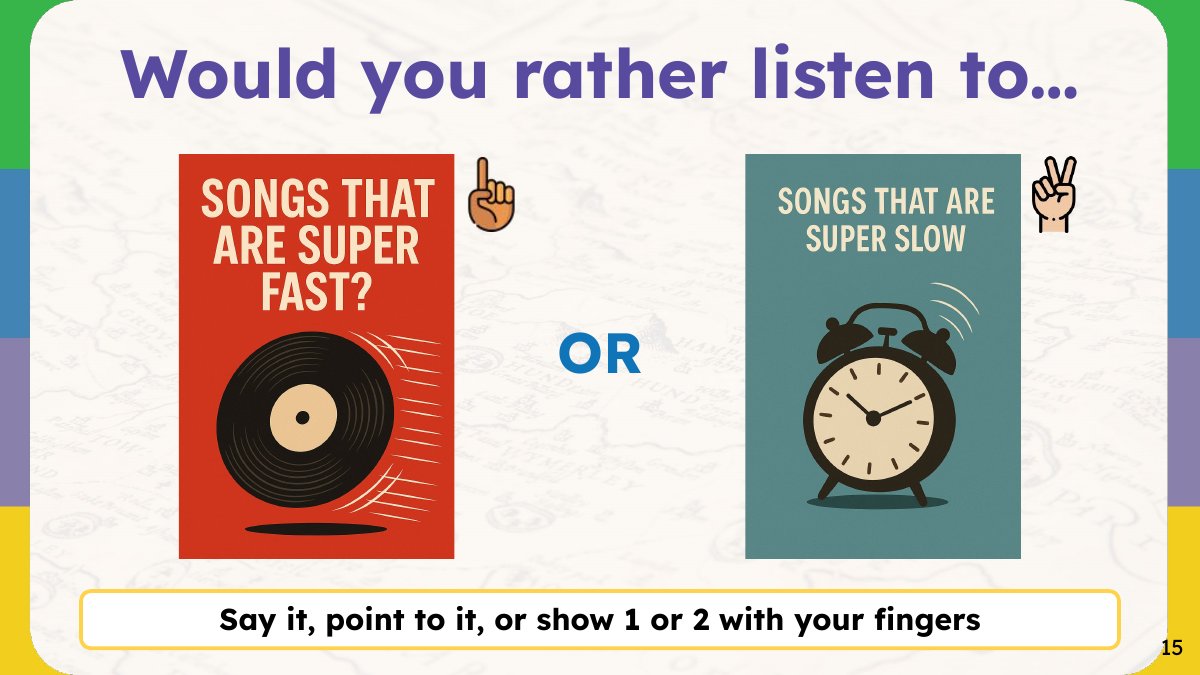
Slide 15 · Would you rather listen to…
4 min. total for activityTempo is one way we can describe music. When we say tempo, we mean how fast or slow the music feels. In Festival Maker, we will pay attention to music features like tempo because they can affect choices in the game.
-
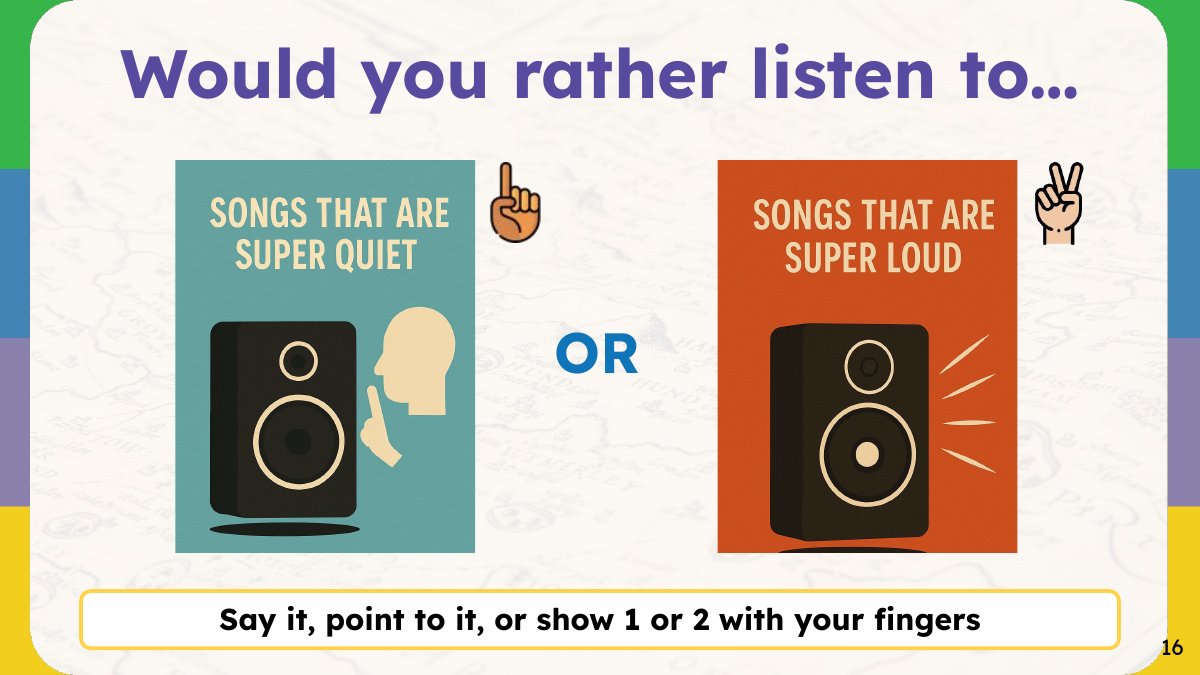
Slide 16 · Would you rather listen to…
4 min. total for activityLoudness is another way we can describe music. When we say loudness, we mean how quiet or loud the music sounds or feels. Festival Maker will ask us to notice features like this so we can make choices using data.
-
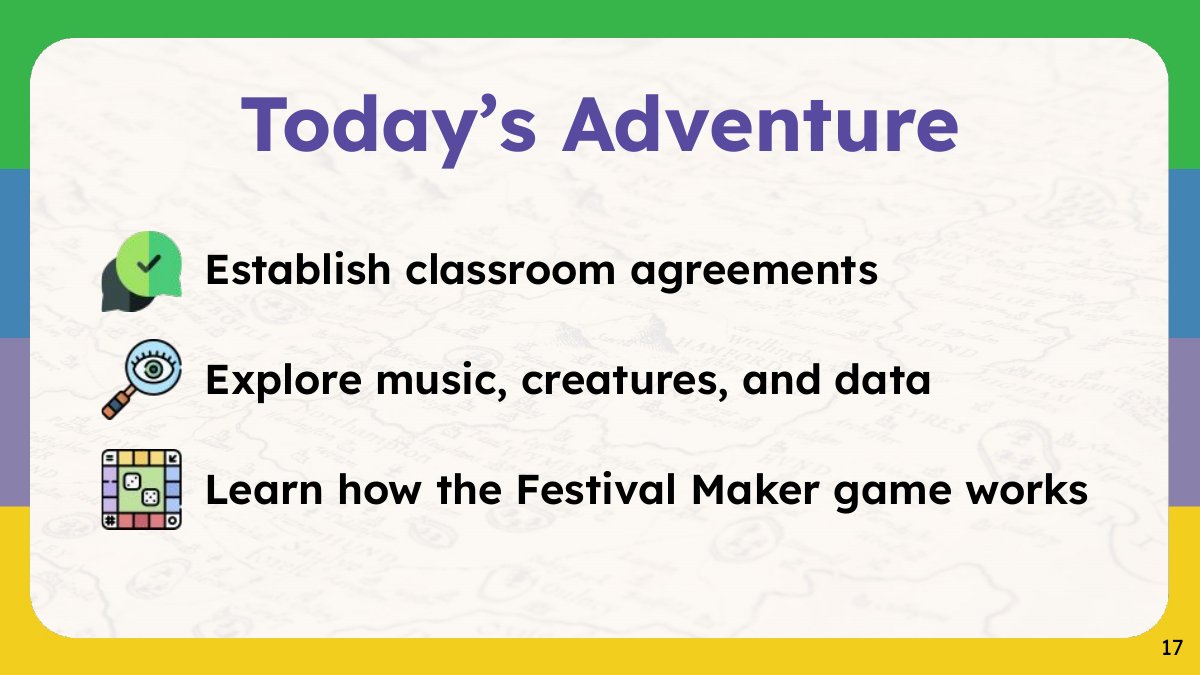
Slide 17 · Today’s Adventure
2 minutes (for slides 18&19)Here’s what we’re doing today. First, we’ll establish classroom agreements so everyone knows how we’ll work together. Then we’ll explore music, creatures, and data. Finally, we’ll learn how the Festival Maker game works. We’ll take it step by step. These are the three main things we are doing today. Today is an introduction, not the full game. You are building readiness to play Festival Maker.
Purpose: Set the agenda,
-
Slide 18 · Our Classroom Agreements
1 minBefore we start, let’s return to our classroom agreements. These agreements help us work as teams, try new ideas, and make sure everyone has a way to participate. As we play today, we will need to listen, take turns, use evidence, and help each other stay with the process.
Do: Be sure to copy and paste co-created agreements.
Purpose: Revisit classrooms agreements.
-
Slide 19 · Station Rotation:
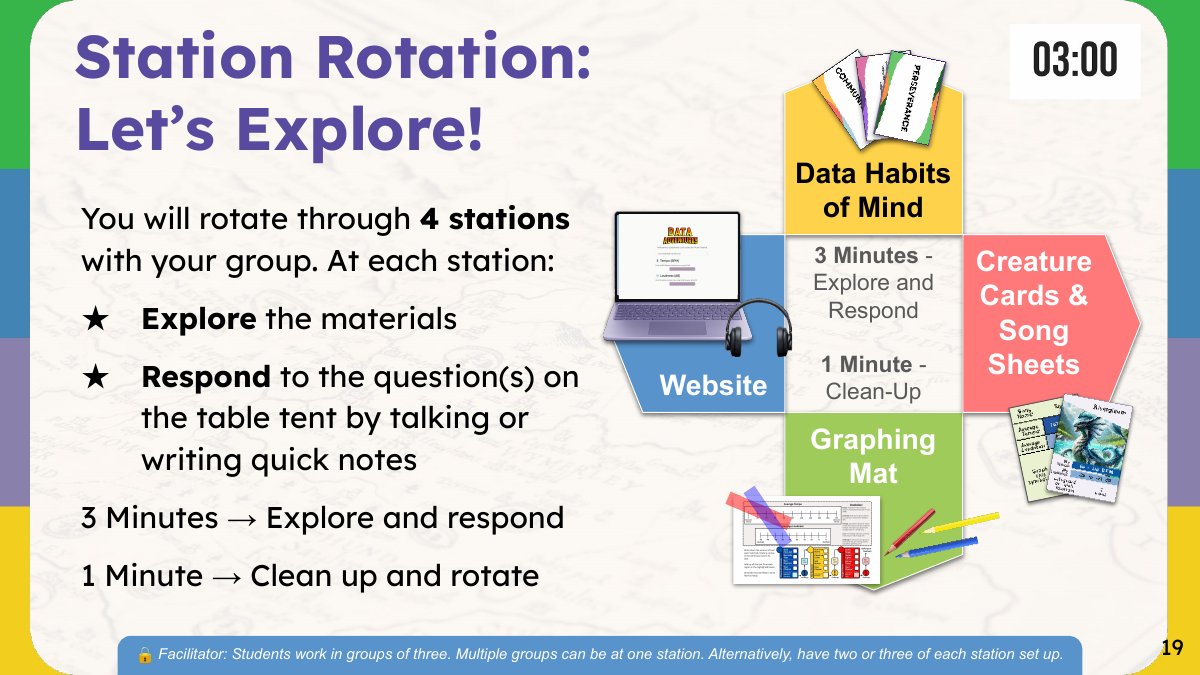
25 min total (slides 19-21)You’ll rotate through four stations with your group. At each station, your job is to explore the materials, talk about what you notice, and respond to the questions on the table tent. You can talk it through with your group or write quick notes. You’ll have 3 minutes to explore and respond, then 1 minute to clean up and rotate. You do not need to master the tool yet. Notice what the materials are, what questions you have, and how the station might connect to music, data, creatures, or the game.
Do: Place students in small groups, ideally groups of three. Rotate groups through four stations: Station 1: Card Discovery Station 2: Website Wonder Station 3: Graphing Mat and Translucent Range Windows Station 4: Data Habits. Use a timer: 3 minutes to explore, discuss, and respond, and 1 minute to clean up and rotate.
Purpose: Centers student voice in creating a learning environment where everyone feels safe, included, and supported to take risks, share ideas, and learn together. Teacher tip: If time is short, prioritize exploration over recording.
-
Slide 20 · Share Out: What did you notice at each station?
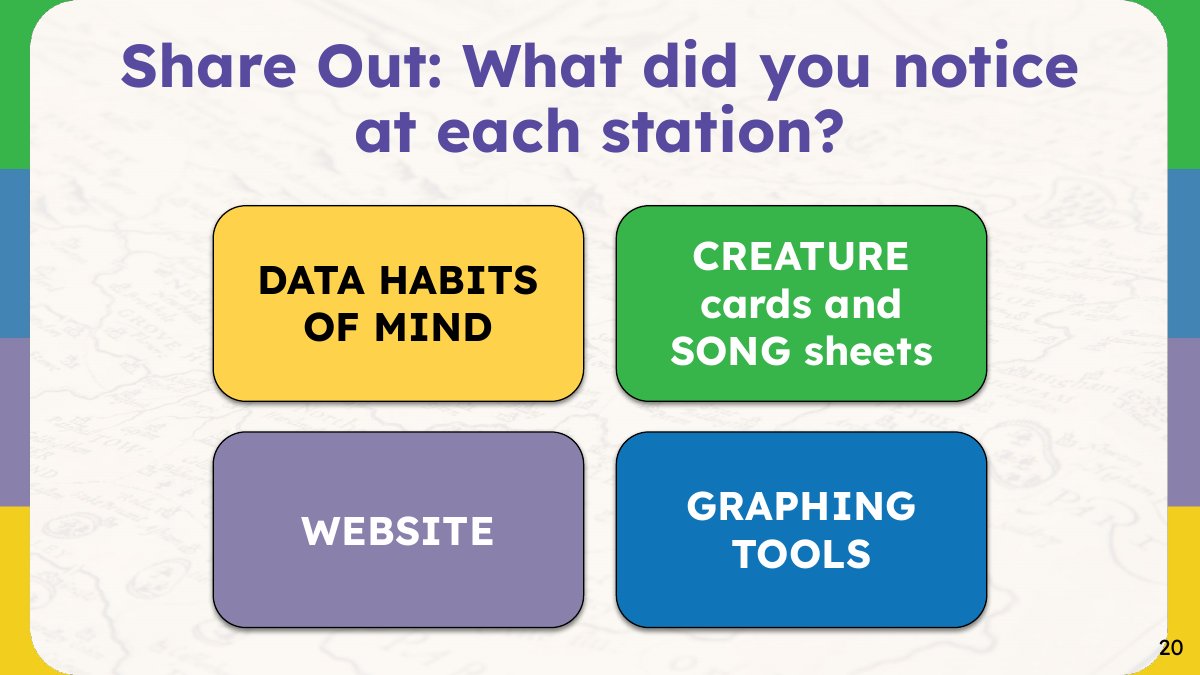
25 min total (slides 19-21)Let’s come back together. Each group will share one discovery from one station. As you share, I’ll record important words and ideas that connect to music, data, graphing, and the game. You do not need to explain everything. Share one thing your group noticed, wondered, or connected to the game.
Do: Invite each group to share one discovery. Record key vocabulary on chart paper, the board, or a document camera.
Purpose: Share out on reflection
-
Slide 21 · Share Out: Let’s Name What We Discovered!
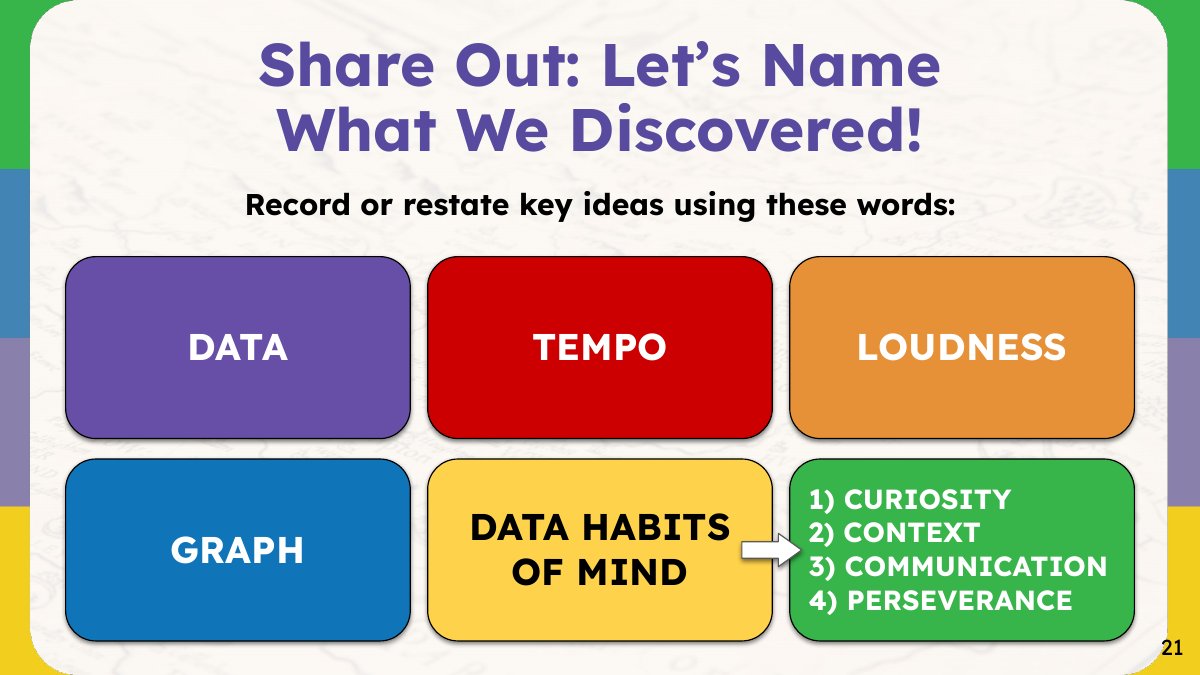
25 min total (slides 19-21)Some of the things you noticed connect to key words we’ll use in Festival Maker. Data is information we can use. Tempo tells us how fast or slow music feels. Just like walking slow versus running fast, music can have a slow tempo, like a sleepy turtle, or a fast tempo, like a running rabbit. Loudness tells us how strong the sound wave is. Loudness is like a ruler for sound, measuring how much energy sound waves have. Instead of inches, we use decibels. A graph helps us organize and see information. Our Data Habits of Mind help us think like data explorers. These words will help us talk about the game, the music, and the choices we make. You do not need to memorize them. We will keep using these words as we play.
-
Slide 22 · The Story of Festival Maker
5 minAs you watch the Festival Maker video, notice what connects to the stations you just explored. Pay attention to music, data, decision-making, and anything that seems connected to collecting data or loot for your future festival. As you watch, pay attention to what the people in the story need help with. Notice what seems connected to music, data, collecting materials, and making decisions. These words will help us talk about the game, the music, and the choices we make. You do not need to memorize them. We will keep using these words as we play.
Do: After viewing, invite students to share observations about: music, data, decision-making, collecting data and loot, future festival design.
-
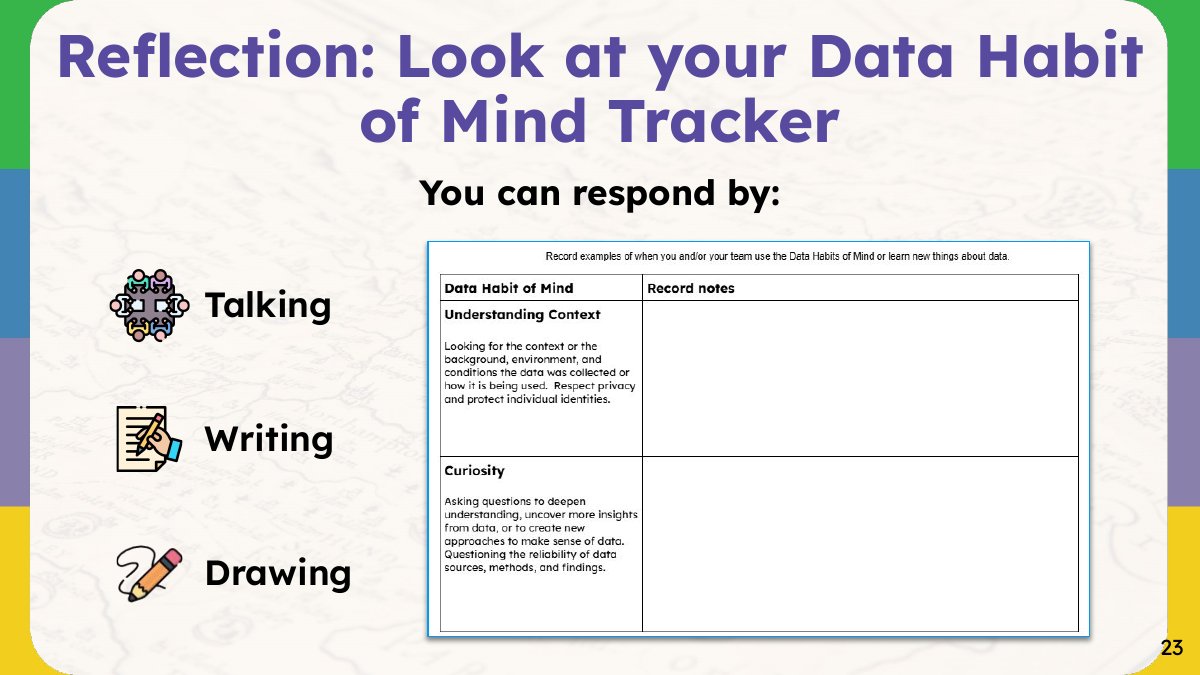
Slide 23 · Reflection: Look at your Data Habit of Mind Tracker
3 minNow make a connection to one of the Data Habits of Mind using your tracker. You can think about curiosity, context, communication, or perseverance. Record your connection in the tracker. You can write, draw, or use words that make sense to you. There is no one right answer. You might have used curiosity when you explored a station, context when you thought about music choices, communication when you shared with a partner, or perseverance when something felt confusing.
Do: Ask students to choose one Data Habit of Mind and have them record a connection in the tracker. Allow multiple response modes: writing, drawing, talking first, or quiet reflection.
Purpose: Connecting back to Data Habits of Mind
-
Slide 24 · Closing Ritual: Creature Reset
1 minTake a moment to breathe before we move on. Imagine your creature finding a calm, safe place in Symphonia. You do not have to say anything out loud. Just take a quiet moment to reset. Use the gif to cue you when to inhale, pause, and exhale..
Do: Play the embedded audio. Give students a quiet moment to breathe or reset.
Purpose: Closing ritual.