Avatar Maker
Lesson 4: Hero's Journey
Students reflect on their growth across the Data Adventure and tell their experience as a Hero's Journey story — in paper or digital form — connecting it to the Data Habits of Mind, data skills, and their STEM identity.
Overview
Students reflect on their growth during the Data Adventure, communicate their learning through various modes, and connect their experiences to the Data Habits of Mind, data literacy practices, and STEM identity by choosing an expression format that matches their interests and preferences.
Student Objectives
- ✓ I can communicate how I used Data Habits of Mind (e.g., curiosity, understanding context, communication) this week.
- ✓ I can identify and describe at least one data skill or practice I engaged in (e.g., describing a distribution, using a measure of center, or visualizing data).
- ✓ I can share how my confidence, experience, or enjoyment in working with data, math, or science has changed.
- ✓ I can express my learning journey in a format that suits my strengths.
At a Glance
Total: 45 minutes-
Welcome & Grounding
5 min · Slides 2–4
A warm-up that gives students individual time to reflect over the week's learning.
-
Agenda & Classroom Agreements
2 min · Slides 6–7
Review the agenda, classroom agreements, and the objectives for the day.
-
Learn About the Hero's Journey & Storytelling
8 min · Slides 8–10
Students watch a short video describing the Hero's Journey storytelling framework, then are briefly reminded of the four parts of a plot and the goal of today's work.
-
Activity: Create Our Hero's Journey
25 min · Slides 11–12
Review the criteria for success for the story (slide 11) and that students work in pairs. Pairs create their own Hero's Journey story about this week's Data Adventure, choosing between writing it on the Planning Sheet or documenting it digitally as a slideshow (slide 12) — both versions share the same prompts and sentence starters. Circulate and help students connect their story to describing data (range, mean, median, mode), data representations (bar chart, dot plot, histogram, heat map, frequency table), and the Data Habits of Mind (communication, curiosity, persistence, understanding context).
-
Reflection & Closing Ritual
5 min · Slides 13–14
If time allows, students share their stories with another group.
| Section | Time | Slides | What happens |
|---|---|---|---|
| Welcome & Grounding | 5 min | 2–4 | A warm-up that gives students individual time to reflect over the week's learning. |
| Agenda & Classroom Agreements | 2 min | 6–7 | Review the agenda, classroom agreements, and the objectives for the day. |
| Learn About the Hero's Journey & Storytelling | 8 min | 8–10 | Students watch a short video describing the Hero's Journey storytelling framework, then are briefly reminded of the four parts of a plot and the goal of today's work. |
| Activity: Create Our Hero's Journey | 25 min | 11–12 | Review the criteria for success for the story (slide 11) and that students work in pairs. Pairs create their own Hero's Journey story about this week's Data Adventure, choosing between writing it on the Planning Sheet or documenting it digitally as a slideshow (slide 12) — both versions share the same prompts and sentence starters. Circulate and help students connect their story to describing data (range, mean, median, mode), data representations (bar chart, dot plot, histogram, heat map, frequency table), and the Data Habits of Mind (communication, curiosity, persistence, understanding context). |
| Reflection & Closing Ritual | 5 min | 13–14 | If time allows, students share their stories with another group. |
Materials & Prep
- Hero's Journey Planning Sheet1 per 2–3 students (if you have students work on paper first)
- Assorted paper and colored pencilsFor students who choose to continue working analog.
- Data Habits of Mind trackerFrom Lesson 2.
- Hero's Journey Digital (student handout)Avatar Maker student handout for pairs creating their story as a digital slideshow. Have the link available for students.
- Decide how students will create the Hero's Journey, or whether you'll give them a choice — e.g., draft on paper first then move to the digital slideshow, or have some pairs work digitally while others work analog on the paper handout.
Slides & Teaching Guide
How to use these speaker notes
Every slide's notes follow the same four labels so you can find what you need at a glance.
- Time:
- Approximate pacing for the slide.
- Example Script:
- Suggested language to say to students. Paraphrase freely to match your voice.
- Do:
- Appears only when a specific action or facilitation move is needed (invite a volunteer, collect a data sheet, etc.). If you don't see a "Do" line, the script is all that's needed.
- Purpose:
- Why the slide is here and what it's building toward in the lesson.
-
Slide 2 · Lesson 4
No teaching notes for this slide.
-
Slide 3 · Day 1
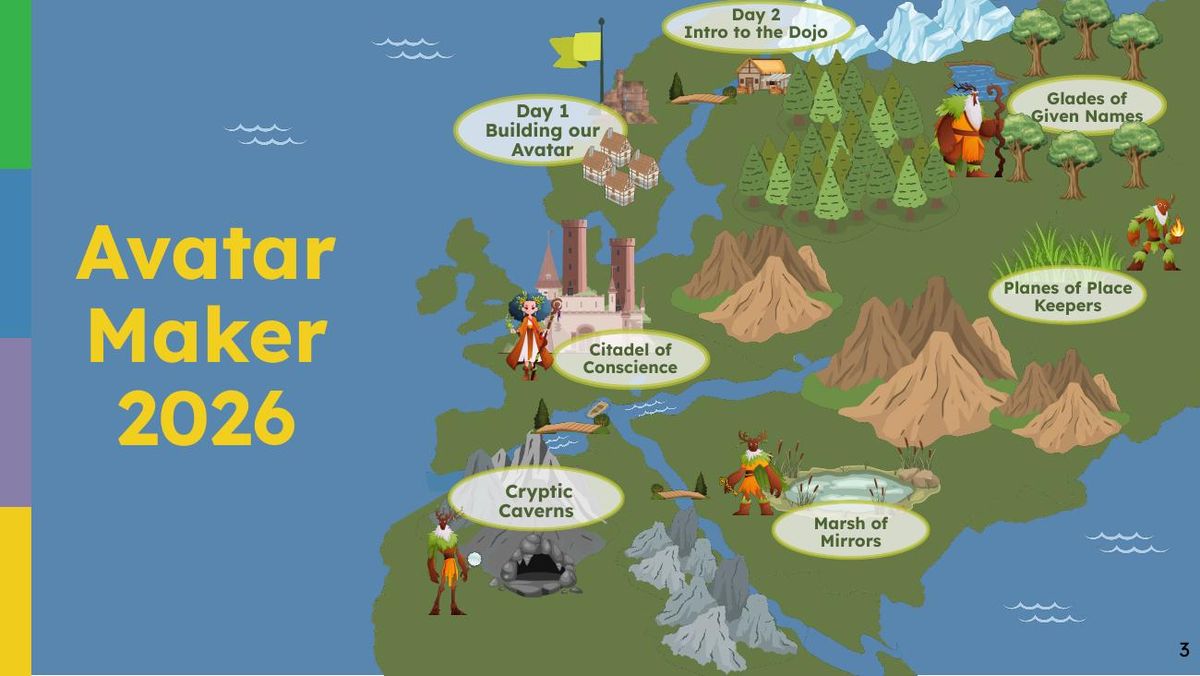
1 min.Today we’ll reflect on everything we’ve done and share our Data Adventure stories. Welcome back, adventurers. Today is the final day of our Data Adventure. You are still helping us test and improve these lessons.
Purpose: Frame lesson as culmination and reflection. Set tone and importance. Reinforce student role in the project.
-
Slide 4 · Warm-Up Directions
3 min.Our first Data Adventure will soon be coming to an end. Every story has a plot. Think about this week—what was a challenging moment, and how did you overcome it?
Purpose: Activate reflection. Connect experience to storytelling.
-
Slide 5 · Optional: Warm Up: Direction Hero’s Journey
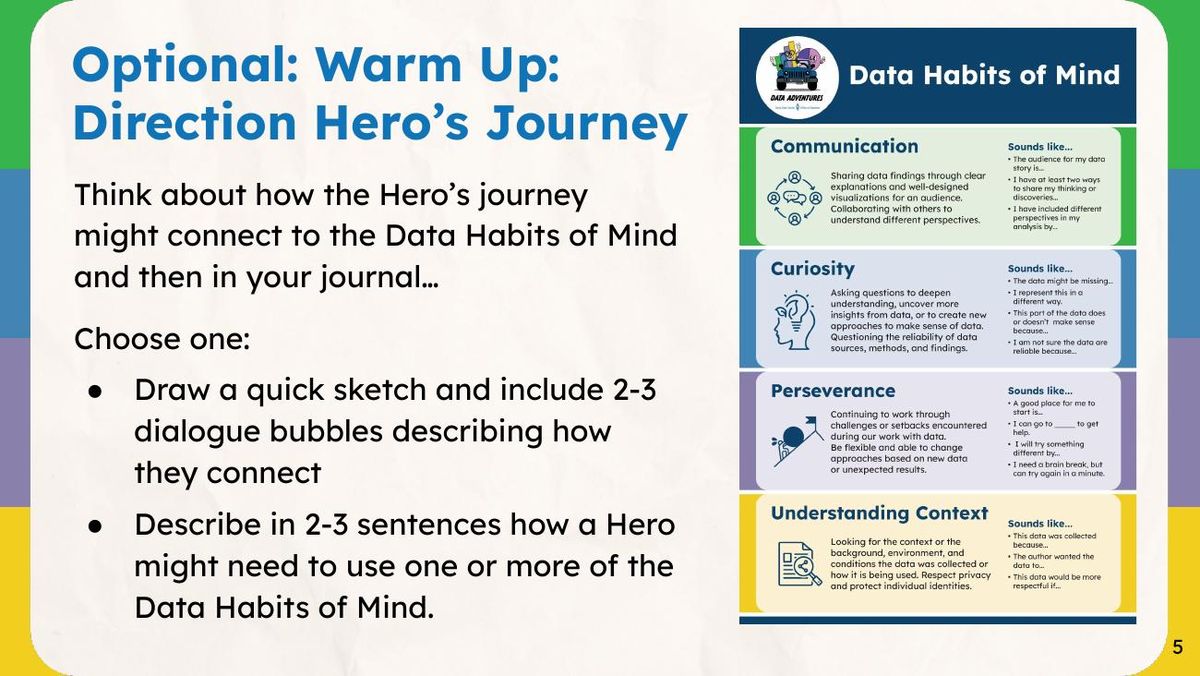
~5 mins (optional: skip if using slide 4 instead)Do: Give students 3–4 minutes to write or sketch independently. You don't need to debrief this, it's a warm-up, not an assessed task. Move directly to slide 6 (Agenda) and then slide 8 (Connector: Hero's Journey video) where the concept gets formally introduced. Note: if you used slide 4 (Warm-Up Directions) as your opener instead, skip this slide to avoid doing two warm-ups back to back.
Purpose: This optional warm-up is an early, low-stakes entry point into the Hero's Journey concept, before the TED-Ed video on slide 8 introduces it more formally. Use it if students need more scaffolding to connect the Data Adventure narrative to storytelling, or if you want a journal activity to open the lesson. Skip it if you're short on time, the concept is introduced again on slide 8 regardless. Script: This week you've been on a Data Adventure, building avatars, sorting data, exploring the Dataverse, and restoring order land by land. All of that is a story. And every good story has a hero. Before we watch a short video about what makes a hero, I want you to think about your own journey this week. In your journal, choose one of the two options on the slide and take 3–4 minutes to respond."
-
Slide 6 · Learn about the Hero’s Journey and key parts to any story
1 min.Today you’ll plan and create a story together in pairs. If we have time we will share it with another group.
Purpose: Provide structure and clarity for the day.
-
Slide 7 · Our Classroom Agreements
1 minBefore we start, let’s return to our classroom agreements. These agreements help us work as teams, try new ideas, and make sure everyone has a way to participate. As we play today, we will need to listen, take turns, use evidence, and help each other stay with the process.
Do: Be sure to copy and paste co-created agreements.
Purpose: Revisit classrooms agreements.
-
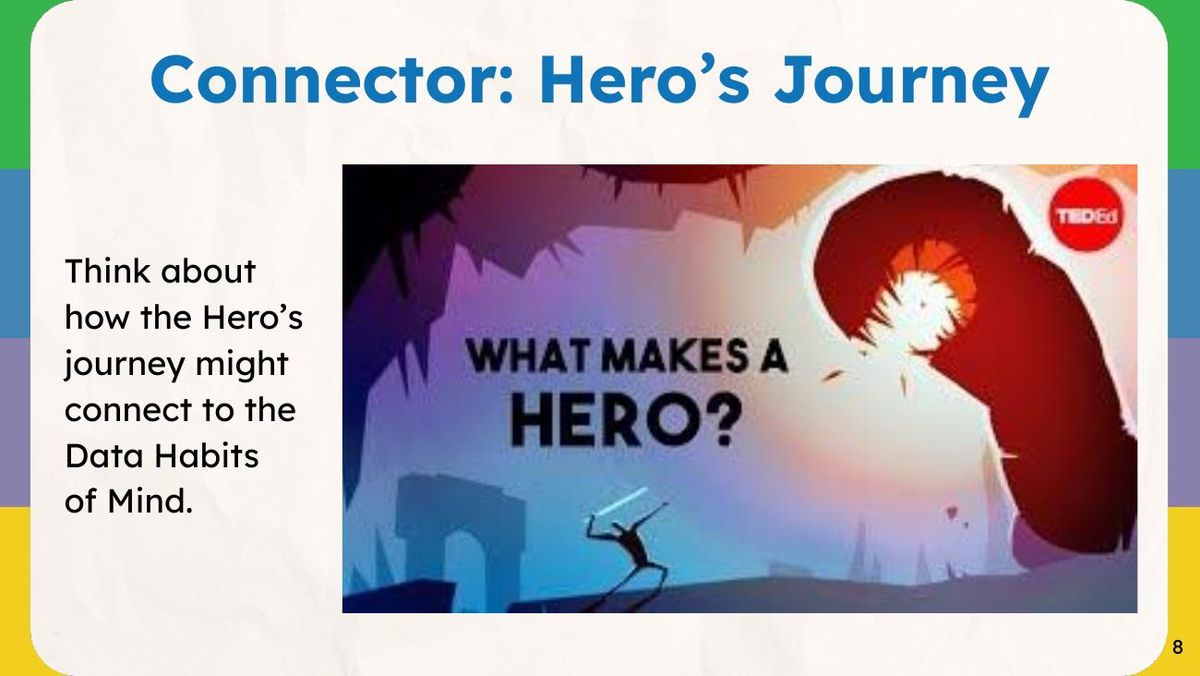
Slide 8 · Connector: Hero’s Journey
5 min.Think about your journey this week—how did you grow as a data adventurer? Which Data Habits of Mind did you really get to dig into? We’re going to watch a short video about heroes and storytelling. As you watch, think about how the Data Habits of Mind connect to a hero’s journey.
Purpose: Bridge personal experience to the final task. Play video.
-
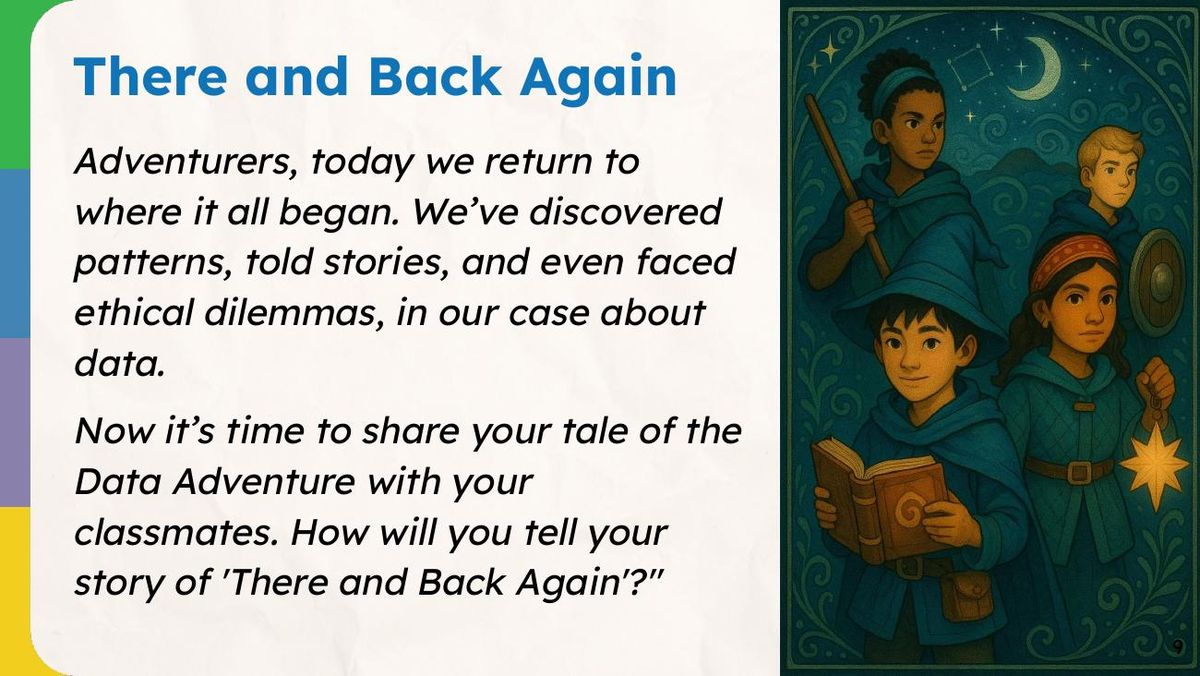
Slide 9 · There and Back Again
1 min.Adventurers, today we return to where it all began. You’ve explored data, found patterns, and told stories. Now it’s time to share your journey—your “There and Back Again” story. Data can be used to tell a story and the graphs we make help communicate that story.
Purpose: Introducing the final task. Build narrative purpose.
-
Slide 10 · All stories share a few things in common
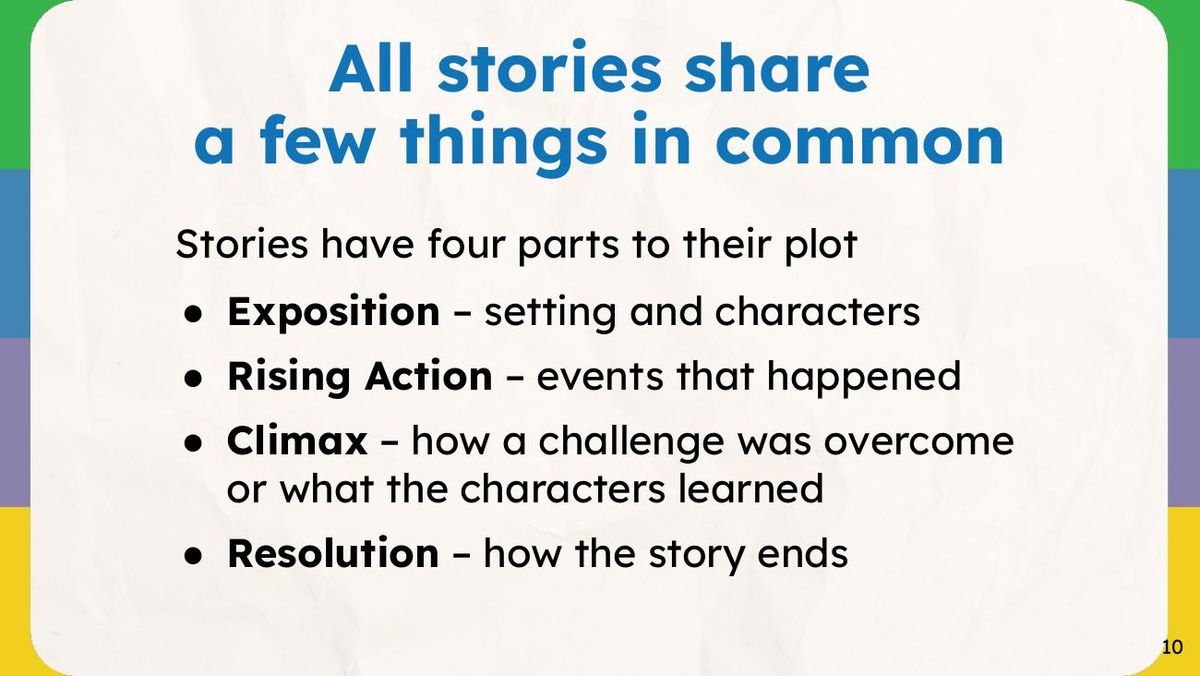
2 min.Have you ever watched a movie and hated the ending? If so, then you didn’t like the resolution. All stories have four main ingredients: exposition, rising action, climax, and resolution. [Describe each one]. You’ll use these four ingredients to structure your Hero’s Journey.
Purpose: Provide structure for student storytelling.
-
Slide 11 · For the Avatar Data Adventure we will tell our Hero’s Story:
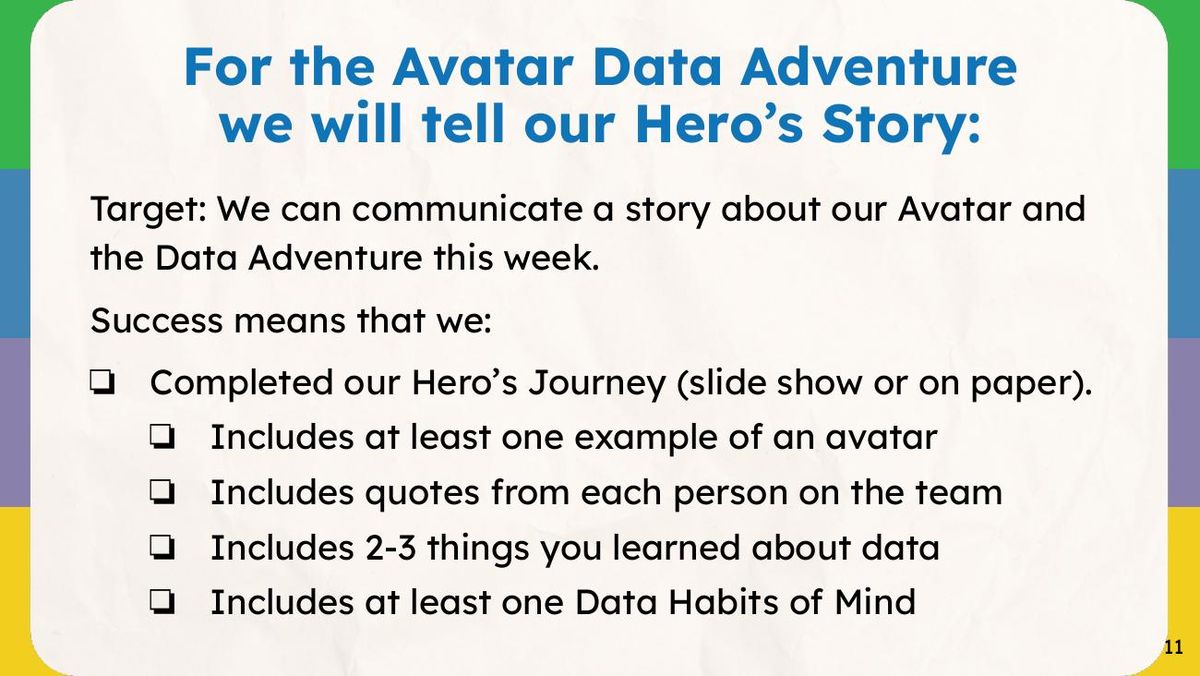
25 min.Everyone tells their story differently—choose the format that works best for your group and start writing. Begin working with your group to plan and create your story. Use your notes and experiences from the week. Keep building your story—make sure you include all required elements.
Do: Leave this slide up while teams work to check their progress.
Purpose: Launch creative work. Emphasize ownership.
-
Slide 12 · Team you can choose between Two Story Formats
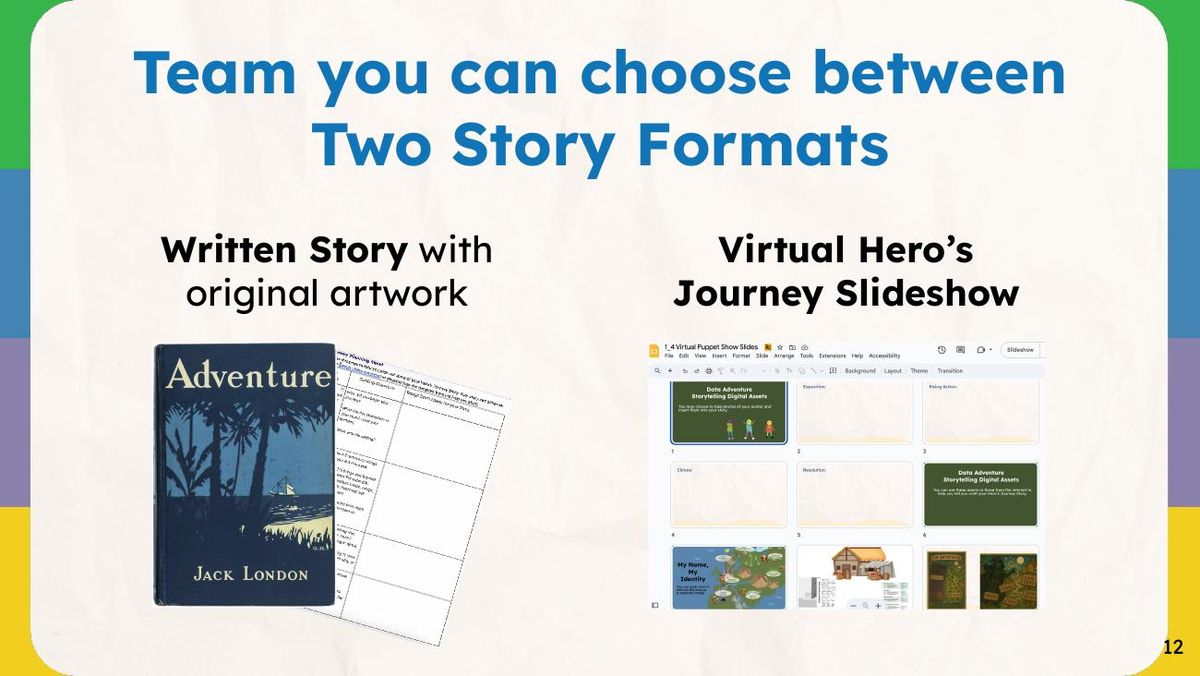
1 min.You can choose how to tell your story—written story or slideshow. Both formats give you sentence starters and ask questions to help you tell your story by incorporating the 4 parts ofa plot. The goal is to create the story first, then focus on illustrating it either on paper or in the slideshow.
Do: Show students the format of both. Be sure to show the students the digital assets to help speed up illustration. Hero’s Journey Planning Sheet Avatar Maker: Hero's Journey Digital
Purpose: Provide student choice (UDL). Increase engagement.
-
Slide 13 · Finally, share your story
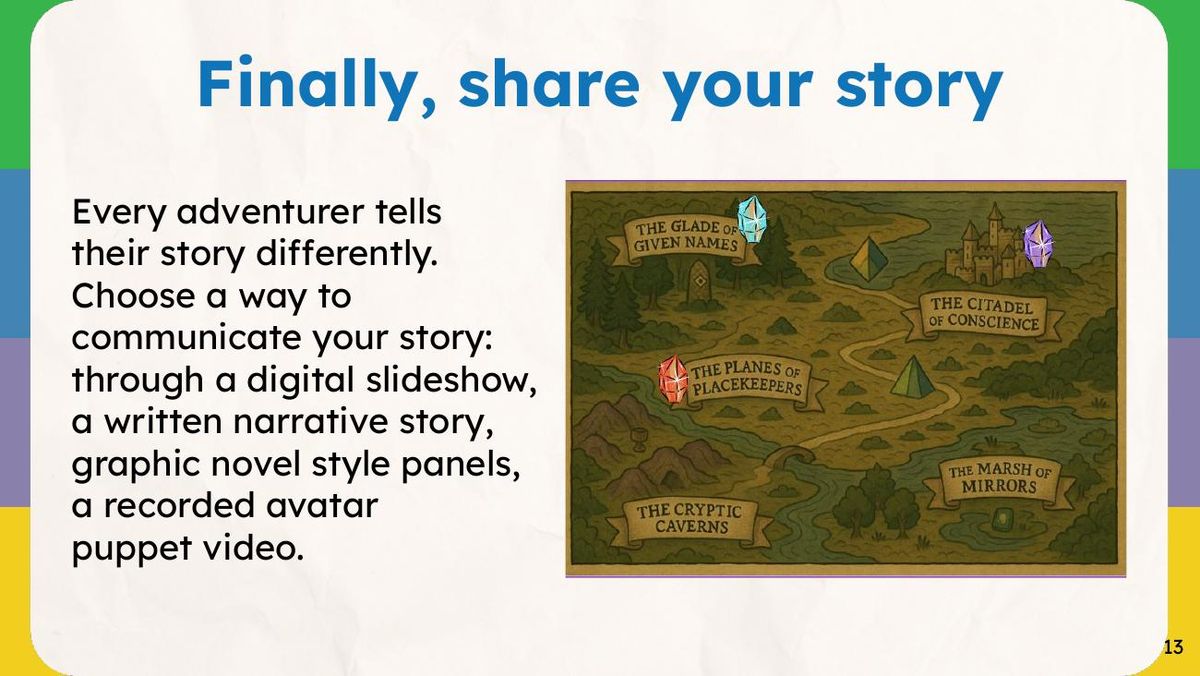
1 min.Every adventurer tells their story differently. Choose a way to communicate your story: through a digital slideshow, a written narrative story, graphic novel style panels, a recorded avatar puppet video.
-
Slide 14 · Find another team that is also done and share your stories!
5 min.If you finish, share your story with another group. Listen and give feedback.
Purpose: Promote communication and reflection.
-
Slide 15 · Avatar Maker
No teaching notes for this slide.